


Page 142 - Ultimate Visual Dictionary (DK)
P. 142
PLANTS

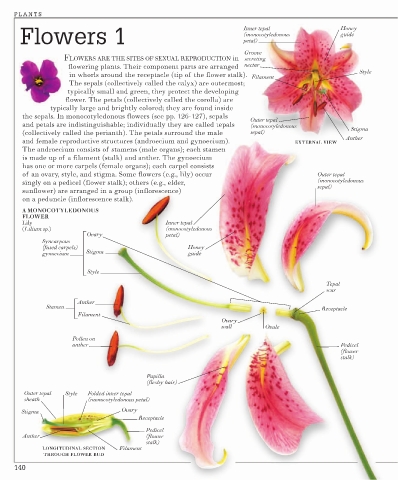
       Flowers 1                                                     Inner tepal                Honey
                                                                     (monocotyledonous
                                                                                                guide
                                                                     petal)
                                                                     Groove
                   FLOWERS ARE THE SITES OF SEXUAL REPRODUCTION in   secreting
                    flowering plants. Their component parts are arranged   nectar
                                                                                                     Style
                    in whorls around the receptacle (tip of the flower stalk).   Filament
                    The sepals (collectively called the calyx) are outermost;
                    typically small and green, they protect the developing
                   flower. The petals (collectively called the corolla) are
               typically large and brightly colored; they are found inside
       the sepals. In monocotyledonous flowers (see pp. 126-127), sepals
                                                                       Outer tepal
       and petals are indistinguishable; individually they are called tepals   (monocotyledonous
                                                                                                  Stigma
       (collectively called the perianth). The petals surround the male   sepal)
                                                                                                 Anther
       and female reproductive structures (androecium and gynoecium).              EXTERNAL VIEW
       The androecium consists of stamens (male organs); each stamen
       is made up of a filament (stalk) and anther. The gynoecium
       has one or more carpels (female organs); each carpel consists
       of an ovary, style, and stigma. Some flowers (e.g., lily) occur                   Outer tepal
       singly on a pedicel (flower stalk); others (e.g., elder,                          (monocotyledonous
                                                                                         sepal)
       sunflower) are arranged in a group (inflorescence)
       on a peduncle (inflorescence stalk).
       A MONOCOTYLEDONOUS
       FLOWER
       Lily                                    Inner tepal
       (Lilium sp.)                            (monocotyledonous
                         Ovary                 petal)
             Syncarpous
             (fused carpels)                         Honey
             gynoecium   Stigma                      guide

                         Style
                                                                                            Tepal
                                                                                            scar
                       Anther
              Stamen                                                                      Receptacle
                       Filament
                                                               Ovary
                                                               wall        Ovule
                     Pollen on
                     anther                                                                     Pedicel
                                                                                                (flower
                                                                                                stalk)

                                          Papilla
                                          (fleshy hair)
        Outer tepal   Style  Folded inner tepal
        sheath           (monocotyledonous petal)
       Stigma                      Ovary
                                       Receptacle
                                          Pedicel
       Anther                             (flower
                                          stalk)
             LONGITUDINAL SECTION   Filament
             THROUGH FLOWER BUD
     140

