


Page 156 - Ultimate Visual Dictionary (DK)
P. 156
PLANTS

       Vegetative                                                ADVENTITIOUS BUD
                                                                 Mexican hat plant
                                                                 (Kalanchoe
                                                                 daigremontiana)             Apex of
                                                                                             leaf
       reproduction


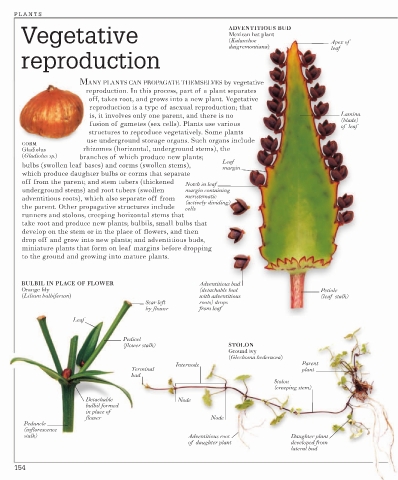
                       MANY PLANTS CAN PROPAGATE THEMSELVES by vegetative
                         reproduction. In this process, part of a plant separates
                          off, takes root, and grows into a new plant. Vegetative
                          reproduction is a type of asexual reproduction; that
                          is, it involves only one parent, and there is no                      Lamina
                                                                                                (blade)
                          fusion of gametes (sex cells). Plants use various                     of  leaf
                          structures to reproduce vegetatively. Some plants
                         use underground storage organs. Such organs include
       CORM
       Gladiolus        rhizomes (horizontal, underground stems), the
       (Gladiolus sp.)  branches of which produce new plants;
                                                               Leaf
       bulbs (swollen leaf bases) and corms (swollen stems),
                                                               margin
       which produce daughter bulbs or corms that separate
       off from the parent; and stem tubers (thickened
                                                    Notch in leaf
       underground stems) and root tubers (swollen   margin containing
       adventitious roots), which also separate off from   meristematic
                                                    (actively dividing)
       the parent. Other propagative structures include   cells
       runners and stolons, creeping horizontal stems that
       take root and produce new plants; bulbils, small bulbs that
       develop on the stem or in the place of flowers, and then
       drop off and grow into new plants; and adventitious buds,
       miniature plants that form on leaf margins before dropping
       to the ground and growing into mature plants.


       BULBIL IN PLACE OF FLOWER                        Adventitious bud
       Orange lily                                      (detachable bud                   Petiole
       (Lilium bulbiferum)                              with adventitious                 (leaf  stalk)
                                         Scar left      roots) drops
                                         by flower      from leaf
                     Leaf

                                   Pedicel
                                   (flower stalk)                STOLON
                                                                 Ground ivy
                                                                 (Glechoma hederacea)
                                                  Internode                          Parent
                                     Terminal                                        plant
                                     bud
                                                                             Stolon
                                                                             (creeping stem)
                         Detachable               Node
                         bulbil formed
                         in place of
                         flower                             Node
        Peduncle
        (inflorescence
        stalk)                                       Adventitious root            Daughter plant
                                                     of  daughter plant           developed from
                                                                                  lateral bud

     154

