


Page 42 - Ultimate Visual Dictionary (DK)
P. 42
THE UNIVERSE

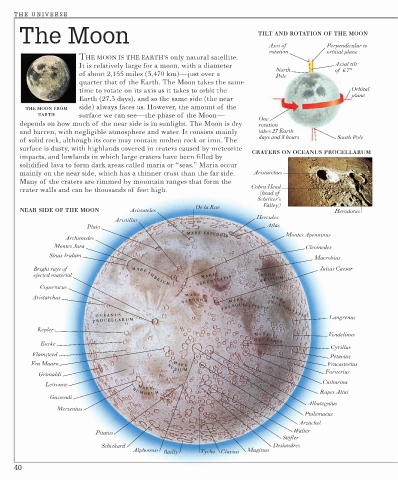
      The Moon                                                           TILT AND ROTATION OF THE MOON

                                                                            Axis of         Perpendicular to
                                                                            rotation        orbital plane
                       THE MOON IS THE EARTH’S only natural satellite.
                       It is relatively large for a moon, with a diameter                     Axial tilt
                                                                              North           of  6.7°
                       of about 2,155 miles (3,470 km)—just over a
                                                                              Pole
                       quarter that of the Earth. The Moon takes the same
                       time to rotate on its axis as it takes to orbit the                         Orbital
                                                                                                   plane
                       Earth (27.3 days), and so the same side (the near
        THE MOON FROM   side) always faces us. However, the amount of the
            EARTH      surface we can see—the phase of the Moon—
                                                                         One
      depends on how much of the near side is in sunlight. The Moon is dry   rotation
      and barren, with negligible atmosphere and water. It consists mainly   takes 27 Earth
                                                                         days and 8 hours      South Pole
      of solid rock, although its core may contain molten rock or iron. The
      surface is dusty, with highlands covered in craters caused by meteorite
                                                                       CRATERS ON OCEANUS PROCELLARUM
      impacts, and lowlands in which large craters have been filled by
      solidified lava to form dark areas called maria or “seas.” Maria occur
      mainly on the near side, which has a thinner crust than the far side.   Aristarchus
      Many of the craters are rimmed by mountain ranges that form the
                                                                       Cobra Head
      crater walls and can be thousands of feet high.
                                                                         (head of
                                                                         Schröter’s
                                                                          Valley)
                                                       De la Rue
       NEAR SIDE OF THE MOON         Aristoteles                                              Herodotus
                                                                        Hercules
                                 Aristillus
                         Plato                                             Atlas
                                                                                Montes Apenninus
                                                     M A R E   F R I G O R I S
                   Archimedes
                Montes Jura                                                           Cleomedes
               Sinus Iridum
                                                                                        Macrobius
          Bright rays of                                                                  Julius Caesar
          ejected material            M A R E   I M B R I U M  M A R E   M A R E
                                                        S E R E N I T A T I S  C R I S I U M
            Copernicus
                                                     M A R E
          Aristarchus
                                                    V A P O R U M  M A R E  M A R E
                                                               T R A N Q U I L L I TAT I S  F E C U N D I T A T I S
                            O C E A N U S                                                   Langrenus
                           P R O C E L L A R U M
           Kepler
                                                                                            Vendelinus
                                                                        M A R E
                                                                        N E C T A R I S
            Encke
                                                                                             Cyrillus
          Flamsteed
                                                                                             Petavius
          Fra Mauro                            N U B I U M                                  Fracastorius
                                                 M A R E
                                                                                           Furnerius
            Grimaldi
                                                                                           Catharina
              Letronne
                                       M A R E
                                                                                          Rupes Altai
                                      H U M O R U M
               Gassendi
                                                                                       Albategnius
                 Mersenius
                                                                                      Ptolemaeus
                                                                                    Arzachel
                                                                                   Walter
                            Pitatus
                                                                                Stöfler
                             Schickard                                       Deslandres
                                      Alphonsus  Bailly  Tycho Clavius  Maginus
     40

