


Page 44 - Ultimate Visual Dictionary (DK)
P. 44
THE UNIVERSE

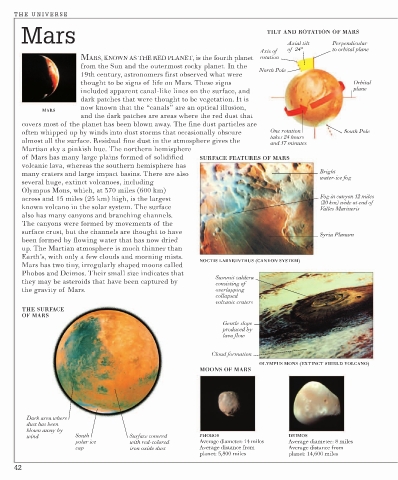
       Mars                                                                TILT AND ROTATION OF MARS
                                                                                 Axial tilt
                                                                                             Perpendicular
                                                                         Axis of    of  24°  to orbital plane
                       MARS, KNOWN AS THE RED PLANET, is the fourth planet  rotation
                       from the Sun and the outermost rocky planet. In the
                                                                         North Pole
                       19th century, astronomers first observed what were
                       thought to be signs of life on Mars. These signs                            Orbital
                                                                                                   plane
                       included apparent canal-like lines on the surface, and
                       dark patches that were thought to be vegetation. It is
                       now known that the “canals” are an optical illusion,
             MARS
                       and the dark patches are areas where the red dust that
       covers most of the planet has been blown away. The fine dust particles are
       often whipped up by winds into dust storms that occasionally obscure   One rotation       South Pole
                                                                            takes 24 hours
       almost all the surface. Residual fine dust in the atmosphere gives the
                                                                            and 37 minutes
       Martian sky a pinkish hue. The northern hemisphere
       of Mars has many large plains formed of solidified   SURFACE FEATURES OF MARS
       volcanic lava, whereas the southern hemisphere has
                                                                                          Bright
       many craters and large impact basins. There are also
                                                                                          water-ice fog
       several huge, extinct volcanoes, including
       Olympus Mons, which, at 370 miles (600 km)
       across and 15 miles (25 km) high, is the largest                                   Fog in canyon 12 miles
                                                                                          (20 km) wide at end of
       known volcano in the solar system. The surface                                     Valles Marineris
       also has many canyons and branching channels.
       The canyons were formed by movements of the
       surface crust, but the channels are thought to have
                                                                                          Syria Planum
       been formed by flowing water that has now dried
       up. The Martian atmosphere is much thinner than
       Earth’s, with only a few clouds and morning mists.
                                                        NOCTIS LABYRINTHUS (CANYON SYSTEM)
       Mars has two tiny, irregularly shaped moons called
       Phobos and Deimos. Their small size indicates that
                                                             Summit caldera
       they may be asteroids that have been captured by      consisting of
       the gravity of Mars.                                  overlapping
                                                             collapsed
                                                             volcanic craters
       THE SURFACE
       OF MARS
                                                               Gentle slope
                                                               produced by
                                                               lava flow

                                                            Cloud formation
                                                                         OLYMPUS MONS (EXTINCT SHIELD VOLCANO)
                                                         MOONS OF MARS


        Dark area where
        dust has been
        blown away by
        wind          South          Surface covered    PHOBOS                   DEIMOS
                      polar ice      with red-colored   Average diameter: 14 miles   Average diameter: 8 miles
                      cap            iron oxide dust    Average distance from    Average distance from
                                                        planet: 5,800 miles      planet: 14,600 miles

     42

