


Page 46 - Ultimate Visual Dictionary (DK)
P. 46
THE UNIVERSE

       Jupiter                                                            TILT AND ROTATION OF JUPITER


                                                                        Axis of  rotation  Axial tilt of  3.1°
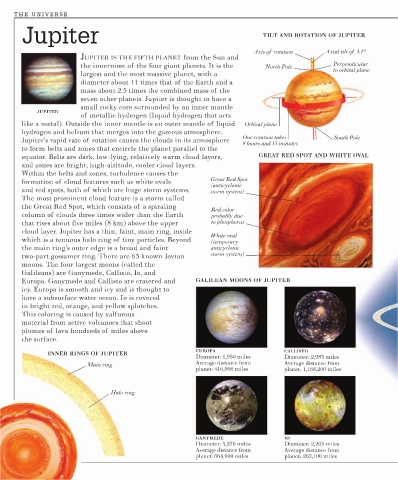
                       JUPITER IS THE FIFTH PLANET from the Sun and
                       the innermost of the four giant planets. It is the   North Pole        Perpendicular
                                                                                              to orbital plane
                       largest and the most massive planet, with a
                       diameter about 11 times that of the Earth and a
                       mass about 2.5 times the combined mass of the
                       seven other planets. Jupiter is thought to have a
                       small rocky core surrounded by an inner mantle
           JUPITER
                       of metallic hydrogen (liquid hydrogen that acts
       like a metal). Outside the inner mantle is an outer mantle of liquid   Orbital plane
       hydrogen and helium that merges into the gaseous atmosphere.
                                                                    One rotation takes        South Pole
       Jupiter’s rapid rate of rotation causes the clouds in its atmosphere
                                                                    9 hours and 55 minutes
       to form belts and zones that encircle the planet parallel to the
       equator. Belts are dark, low-lying, relatively warm cloud layers,   GREAT RED SPOT AND WHITE OVAL
       and zones are bright, high-altitude, cooler cloud layers.
       Within the belts and zones, turbulence causes the
                                                           Great Red Spot
       formation of cloud features such as white ovals
                                                           (anticyclonic
       and red spots, both of which are huge storm systems.   storm system)
       The most prominent cloud feature is a storm called
       the Great Red Spot, which consists of a spiraling
                                                            Red color
       column of clouds three times wider than the Earth    probably due
       that rises about five miles (8 km) above the upper   to phosphorus
       cloud layer. Jupiter has a thin, faint, main ring, inside
                                                            White oval
       which is a tenuous halo ring of tiny particles. Beyond
                                                            (temporary
       the main ring’s outer edge is a broad and faint      anticyclonic
       two-part gossamer ring. There are 63 known Jovian    storm system)
       moons. The four largest moons (called the
       Galileans) are Ganymede, Callisto, Io, and
       Europa. Ganymede and Callisto are cratered and   GALILEAN MOONS OF JUPITER
       icy. Europa is smooth and icy and is thought to
       have a subsurface water ocean. Io is covered
       in bright red, orange, and yellow splotches.
       This coloring is caused by sulfurous
       material from active volcanoes that shoot
       plumes of lava hundreds of miles above
       the surface.

                                                       EUROPA                   CALLISTO
              INNER RINGS OF JUPITER
                                                       Diameter: 1,950 miles    Diameter: 2,983 miles
                         Main ring                     Average distance from    Average distance from
                                                       planet: 416,900 miles    planet: 1,168,200 miles

                                Halo ring


                                                       GANYMEDE                 IO
                                                       Diameter: 3,270 miles    Diameter: 2,263 miles
                                                       Average distance from    Average distance from
                                                       planet: 664,900 miles    planet: 262,100 miles

