


Page 60 - Ultimate Visual Dictionary (DK)
P. 60
PREHISTORIC EAR TH
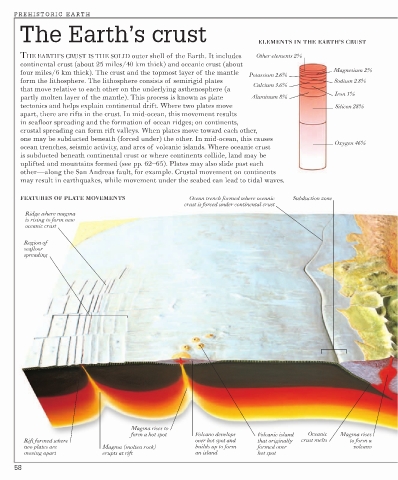
      The Earth’s crust                                                  ELEMENTS IN THE EARTH’S CRUST


       THE EARTH’S CRUST IS THE SOLID outer shell of the Earth. It includes   Other elements 2%
       continental crust (about 25 miles/40 km thick) and oceanic crust (about
       four miles/6 km thick). The crust and the topmost layer of the mantle   Potassium 2.6%  Magnesium 2%
       form the lithosphere. The lithosphere consists of semirigid plates                     Sodium 2.8%
                                                                       Calcium 3.6%
       that move relative to each other on the underlying asthenosphere (a
                                                                                              Iron 5%
       partly molten layer of the mantle). This process is known as plate   Aluminum 8%
       tectonics and helps explain continental drift. Where two plates move                   Silicon 28%
       apart, there are rifts in the crust. In mid-ocean, this movement results
       in seafloor spreading and the formation of ocean ridges; on continents,
       crustal spreading can form rift valleys. When plates move toward each other,
       one may be subducted beneath (forced under) the other. In mid-ocean, this causes
                                                                                              Oxygen 46%
       ocean trenches, seismic activity, and arcs of volcanic islands. Where oceanic crust
       is subducted beneath continental crust or where continents collide, land may be
       uplifted and mountains formed (see pp. 62–65). Plates may also slide past each
       other—along the San Andreas fault, for example. Crustal movement on continents
       may result in earthquakes, while movement under the seabed can lead to tidal waves.

       FEATURES OF PLATE MOVEMENTS                    Ocean trench formed where oceanic    Subduction zone
                                                    crust is forced under continental crust
        Ridge where magma
        is rising to form new
        oceanic crust

        Region of
        seafloor
        spreading


                                     Magma rises to
                                     form a hot spot   Volcano develops   Volcanic island   Oceanic   Magma rises
        Rift formed where                              over hot spot and   that originally   crust melts  to form a
        two plates are       Magma (molten rock)       builds up to form   formed over             volcano
        moving apart         erupts at rift            an island         hot spot

     58

