


Page 62 - Ultimate Visual Dictionary (DK)
P. 62
PREHISTORIC EAR TH

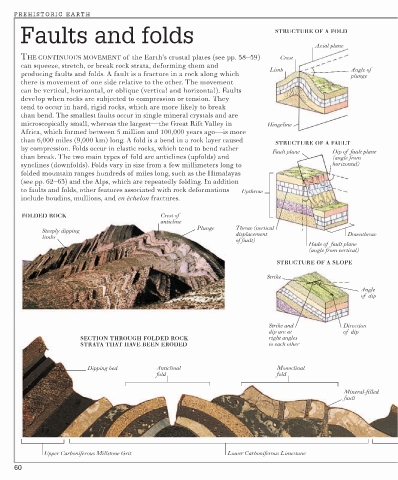
       Faults and folds                                                      STRUCTURE OF A FOLD

                                                                                         Axial plane
       THE CONTINUOUS MOVEMENT of the Earth’s crustal plates (see pp. 58–59)   Crest
       can squeeze, stretch, or break rock strata, deforming them and
                                                                            Limb                  Angle of
       producing faults and folds. A fault is a fracture in a rock along which                    plunge
       there is movement of one side relative to the other. The movement
       can be vertical, horizontal, or oblique (vertical and horizontal). Faults
       develop when rocks are subjected to compression or tension. They
       tend to occur in hard, rigid rocks, which are more likely to break
       than bend. The smallest faults occur in single mineral crystals and are
       microscopically small, whereas the largest—the Great Rift Valley in   Hingeline
       Africa, which formed between 5 million and 100,000 years ago—is more
       than 6,000 miles (9,000 km) long. A fold is a bend in a rock layer caused
                                                                              STRUCTURE OF A FAULT
       by compression. Folds occur in elastic rocks, which tend to bend rather
                                                                             Fault plane     Dip of  fault plane
       than break. The two main types of fold are anticlines (upfolds) and                   (angle from
       synclines (downfolds). Folds vary in size from a few millimeters long to              horizontal)
       folded mountain ranges hundreds of miles long, such as the Himalayas
       (see pp. 62–63) and the Alps, which are repeatedly folding. In addition
       to faults and folds, other features associated with rock deformations    Upthrow
       include boudins, mullions, and en échelon fractures.

       FOLDED ROCK                            Crest of
                                              anticline
                                                        Plunge    Throw (vertical
             Steeply dipping                                      displacement                    Downthrow
             limbs
                                                                  of fault)
                                                                                       Hade of  fault plane
                                                                                       (angle from vertical)
                                                                              STRUCTURE OF A SLOPE

                                                                           Strike
                                                                                                     Angle
                                                                                                     of  dip


                                                                            Strike and          Direction
                                                                            dip are at          of  dip
                       SECTION THROUGH FOLDED ROCK                          right angles
                       STRATA THAT HAVE BEEN ERODED                         to each other


                         Dipping bed        Anticlinal                        Monoclinal
                                            fold                              fold

                                                                                                 Mineral-filled
                                                                                                 fault


             Upper Carboniferous Millstone Grit                 Lower Carboniferous Limestone

     60

