


Page 66 - Ultimate Visual Dictionary (DK)
P. 66
PREHISTORIC EAR TH

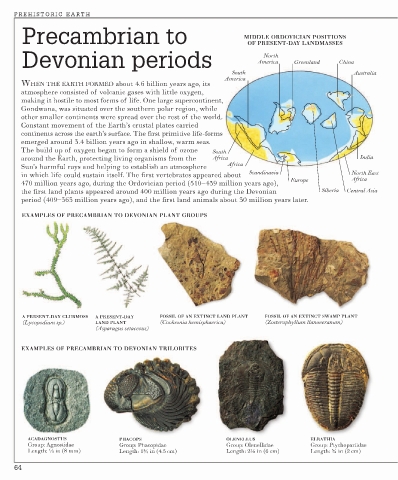
       Precambrian to                                                MIDDLE ORDOVICIAN POSITIONS
                                                                      OF PRESENT-DAY LANDMASSES
       Devonian periods                                                  America   Greenland   China
                                                                          North
                                                                 South                             Australia
                                                               America
       WHEN THE EARTH FORMED about 4.6 billion years ago, its
       atmosphere consisted of volcanic gases with little oxygen,
       making it hostile to most forms of life. One large supercontinent,
       Gondwana, was situated over the southern polar region, while
       other smaller continents were spread over the rest of the world.
       Constant movement of the Earth’s crustal plates carried
       continents across the earth’s surface. The first primitive life-forms
       emerged around 3.4 billion years ago in shallow, warm seas.
       The build up of oxygen began to form a shield of ozone   South
       around the Earth, protecting living organisms from the   Africa                               India
                                                                Africa
       Sun’s harmful rays and helping to establish an atmosphere
       in which life could sustain itself. The first vertebrates appeared about   Scandinavia      North East
                                                                                  Europe           Africa
       470 million years ago, during the Ordovician period (510–439 million years ago),
       the first land plants appeared around 400 million years ago during the Devonian    Siberia  Central Asia
       period (409–363 million years ago), and the first land animals about 30 million years later.

        EXAMPLES OF PRECAMBRIAN TO DEVONIAN PLANT GROUPS


       A PRESENT-DAY CLUBMOSS  A PRESENT-DAY   FOSSIL OF AN EXTINCT LAND PLANT  FOSSIL OF AN EXTINCT SWAMP PLANT
       (Lycopodium sp.)     LAND PLANT       (Cooksonia hemisphaerica)     (Zosterophyllum llanoveranum)
                            (Asparagus setaceous)

       EXAMPLES OF PRECAMBRIAN TO DEVONIAN TRILOBITES


         ACADAGNOSTUS             PHACOPS                       OLENELLUS              ELRATHIA
         Group: Agnostidae        Group: Phacopidae             Group: Olenellidae     Group: Ptychopariidae
         Length: ⅓ in (8 mm)      Length: 1¾ in (4.5 cm)        Length: 2½ in (6 cm)   Length: ¾ in (2 cm)

     64

