


Page 68 - Ultimate Visual Dictionary (DK)
P. 68
PREHISTORIC EAR TH

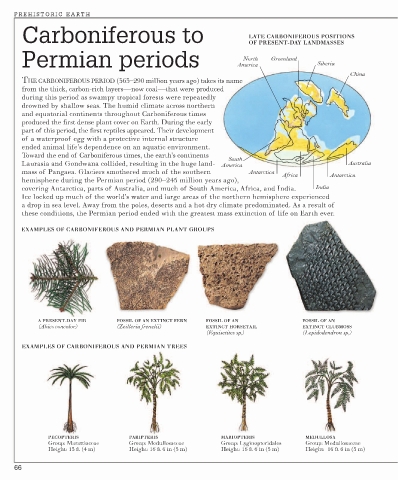
       Carboniferous to                                               LATE CARBONIFEROUS POSITIONS
                                                                      OF PRESENT-DAY LANDMASSES
       Permian periods                                             America  Greenland    Siberia
                                                                     North
                                                                                                  China
       THE CARBONIFEROUS PERIOD (363–290 million years ago) takes its name
       from the thick, carbon-rich layers—now coal—that were produced
       during this period as swampy tropical forests were repeatedly
       drowned by shallow seas. The humid climate across northern
       and equatorial continents throughout Carboniferous times
       produced the first dense plant cover on Earth. During the early
       part of this period, the first reptiles appeared. Their development
       of a waterproof egg with a protective internal structure
       ended animal life’s dependence on an aquatic environment.
       Toward the end of Carboniferous times, the earth’s continents
                                                                 South
       Laurasia and Gondwana collided, resulting in the huge land- America                        Australia
       mass of Pangaea. Glaciers smothered much of the southern       Antarctica
                                                                               Africa        Antarctica
       hemisphere during the Permian period (290–245 million years ago),
       covering Antarctica, parts of Australia, and much of South America, Africa, and India.   India
       Ice locked up much of the world’s water and large areas of the northern hemisphere experienced
       a drop in sea level. Away from the poles, deserts and a hot dry climate predominated. As a result of
       these conditions, the Permian period ended with the greatest mass extinction of life on Earth ever.


       EXAMPLES OF CARBONIFEROUS AND PERMIAN PLANT GROUPS


            A PRESENT-DAY FIR    FOSSIL OF AN EXTINCT FERN  FOSSIL OF AN             FOSSIL OF AN
            (Abies concolor)     (Zeilleria frenzlii)     EXTINCT HORSETAIL          EXTINCT CLUBMOSS
                                                          (Equisetites sp.)          (Lepidodendron sp.)

       EXAMPLES OF CARBONIFEROUS AND PERMIAN TREES


              PECOPTERIS             PARIPTERIS               MARIOPTERIS             MEDULLOSA
              Group: Marattiaceae    Group: Medullosaceae     Group: Lyginopteridales   Group: Medullosaceae
              Height: 13 ft (4 m)    Height: 16 ft 6 in (5 m)  Height: 16 ft 6 in (5 m)  Height:  16 ft 6 in (5 m)

     66

