


Page 338 - The Complete Dog Breed Book Choose the Perfect Dog for You, New Edition (DK)
P. 338
338      C ARE AND TR AINING


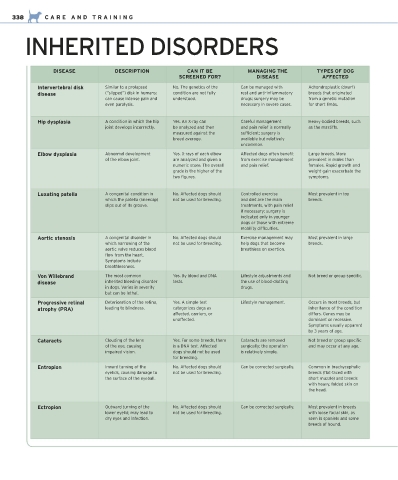
        INHERITED DISORDERS


                DISEASE          DESCRIPTION         CAN IT BE        MANAGING THE       TYPES OF DOG
                                                   SCREENED FOR?        DISEASE            AFFECTED
           Intervertebral disk   Similar to a prolapsed   No. The genetics of the   Can be managed with    Achondroplastic (dwarf)
           disease            (“slipped”) disk in humans;   condition are not fully   rest and anti-inflammatory   breeds that originated
                              can cause intense pain and   understood.  drugs; surgery may be   from a genetic mutation
                              even paralysis.                       necessary in severe cases.  for short limbs.

           Hip dysplasia      A condition in which the hip   Yes. An X-ray can    Careful management    Heavy-bodied breeds, such
                              joint develops incorrectly.  be analyzed and then   and pain relief is normally   as the mastiffs.
                                                 measured against the   sufficient; surgery is
                                                 breed average.     available but relatively
                                                                    uncommon.
           Elbow dysplasia    Abnormal development    Yes. X-rays of each elbow   Affected dogs often benefit   Large breeds. More
                              of the elbow joint.  are analyzed and given a   from exercise management   prevalent in males than
                                                 numeric score. The overall   and pain relief.  females. Rapid growth and
                                                 grade is the higher of the            weight gain exacerbate the
                                                 two figures.                          symptoms.

           Luxating patella   A congenital condition in   No. Affected dogs should   Controlled exercise    Most prevalent in toy
                              which the patella (kneecap)   not be used for breeding.  and diet are the main   breeds.
                              slips out of its groove.              treatments, with pain relief
                                                                    if necessary; surgery is
                                                                    indicated only in younger
                                                                    dogs or those with extreme
                                                                    mobility difficulties.
           Aortic stenosis    A congenital disorder in   No. Affected dogs should   Exercise management may   Most prevalent in large
                              which narrowing of the   not be used for breeding.  help dogs that become   breeds.
                              aortic valve reduces blood            breathless on exertion.
                              flow from the heart.
                              Symptoms include
                              breathlessness.
           Von Willebrand     The most common    Yes. By blood and DNA   Lifestyle adjustments and   Not breed or group specific.
           disease            inherited bleeding disorder   tests.  the use of blood-clotting
                              in dogs. Varies in severity           drugs.
                              but can be lethal.
           Progressive retinal   Deterioration of the retina,   Yes. A simple test   Lifestyle management.   Occurs in most breeds, but
           atrophy (PRA)      leading to blindness.  categorizes dogs as               inheritance of the condition
                                                 affected, carriers, or                differs. Genes may be
                                                 unaffected.                           dominant or recessive.
                                                                                       Symptoms usually apparent
                                                                                       by 3 years of age.
           Cataracts          Clouding of the lens    Yes. For some breeds, there    Cataracts are removed   Not breed or group specific
                              of the eye, causing   is a DNA test. Affected   surgically; the operation    and may occur at any age.
                              impaired vision.   dogs should not be used    is relatively simple.
                                                 for breeding.
           Entropion          Inward turning of the   No. Affected dogs should   Can be corrected surgically.  Common in brachycephalic
                              eyelids, causing damage to   not be used for breeding.   breeds (flat-faced with
                              the surface of the eyeball.                              short muzzle) and breeds
                                                                                       with heavy, folded skin on
                                                                                       the head.

           Ectropion          Outward turning of the   No. Affected dogs should   Can be corrected surgically.  Most prevalent in breeds
                              lower eyelid; may lead to   not be used for breeding.    with loose facial skin, as
                              dry eyes and infection.                                  seen in spaniels and some
                                                                                       breeds of hound.


   US_338-339_Health_5.indd   338                                                                    10/09/19   3:42 PM

