


Page 339 - The Complete Dog Breed Book Choose the Perfect Dog for You, New Edition (DK)
P. 339
HEAL TH       339


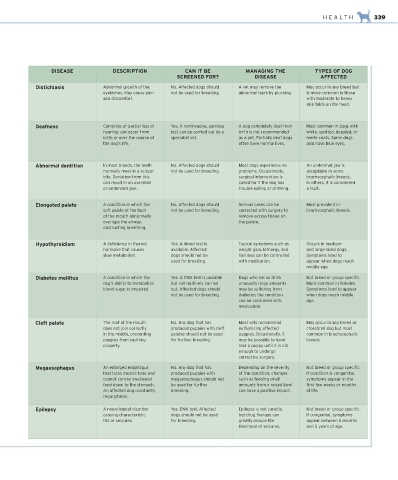
               DISEASE          DESCRIPTION         CAN IT BE        MANAGING THE        TYPES OF DOG
                                                  SCREENED FOR?         DISEASE           AFFECTED
           Distichiasis       Abnormal growth of the   No. Affected dogs should   A vet may remove the   May occur in any breed but
                              eyelashes. May cause pain   not be used for breeding.  abnormal hairs by plucking.  is more common in those
                              and discomfort.                                         with moderate to heavy
                                                                                      skin folds on the head.

           Deafness           Complete or partial loss of   Yes. A noninvasive, painless   A dog completely deaf from   Most common in dogs with
                              hearing; can occur from   test can be carried out by a   birth is not recommended   white, spotted, dappled, or
                              birth or over the course of   specialist vet.  as a pet. Partially deaf dogs   merle coats. Some dogs
                              the dog’s life.                      often have normal lives.  also have blue eyes.


           Abnormal dentition  In most breeds, the teeth   No. Affected dogs should   Most dogs experience no   An undershot jaw is
                              normally meet in a scissor   not be used for breeding.  problems. Occasionally,   acceptable in some
                              bite. Deviation from this            surgical intervention is   brachycephalic breeds.
                              can result in an overshot            called for if the dog has   In others, it is considered
                              or undershot jaw.                    trouble eating or drinking.  a fault.

           Elongated palate   A condition in which the   No. Affected dogs should   Serious cases can be   Most prevalent in
                              soft palate at the back    not be used for breeding.  corrected with surgery to   brachycephalic breeds.
                              of the mouth abnormally              remove excess tissue on
                              overlaps the airway,                 the palate.
                              obstructing breathing.

           Hypothyroidism     A deficiency in thyroid   Yes. A blood test is   Typical symptoms such as   Occurs in medium-
                              hormone that causes    available. Affected    weight gain, lethargy, and   and large-sized dogs.
                              slow metabolism.   dogs should not be    hair loss can be controlled   Symptoms tend to
                                                 used for breeding.  with medication.  appear when dogs reach
                                                                                      middle age.
           Diabetes mellitus  A condition in which the   Yes. A DNA test is possible   Dogs who eat or drink   Not breed or group specific.
                              dog’s ability to metabolize   but not routinely carried   unusually large amounts   More common in females.
                              blood sugar is impaired.  out. Affected dogs should   may be suffering from   Symptoms tend to appear
                                                 not be used for breeding.  diabetes; the condition    when dogs reach middle
                                                                   can be controlled with   age.
                                                                   medication.

           Cleft palate       The roof of the mouth    No. Any dog that has   Most vets recommend   May occur in any breed or
                              does not join correctly    produced puppies with cleft   euthanizing affected   crossbred dog but most
                              in the middle, preventing   palates should not be used   puppies. Occasionally, it   common in brachycephalic
                              puppies from suckling   for further breeding.  may be possible to hand   breeds.
                              properly.                            rear a puppy until it is old
                                                                   enough to undergo
                                                                   corrective surgery.
           Megaesophagus      An enlarged esophagus   No. Any dog that has    Depending on the severity   Not breed or group specific.
                              that lacks muscle tone and   produced puppies with   of the condition, changes   If condition is congenital,
                              cannot convey swallowed   megaesophagus should not   such as feeding small   symptoms appear in the
                              food down to the stomach.   be used for further   amounts from a raised bowl   first few weeks or months
                              An affected dog constantly   breeding.  can have a positive impact.  of life.
                              regurgitates.
           Epilepsy           A neurological disorder   Yes. DNA test. Affected   Epilepsy is not curable,    Not breed or group specific.
                              causing characteristic    dogs should not be used    but drug therapy can   If congenital, symptoms
                              fits or seizures.  for breeding.     greatly reduce the   appear between 6 months
                                                                   likelihood of seizures.  and 5 years of age.


   US_338-339_Health_5.indd   339                                                                    10/09/19   3:42 PM

