


Page 122 - Easy Japanese - Learn to Speak Japanese Quickly! (TUTTLE)
P. 122
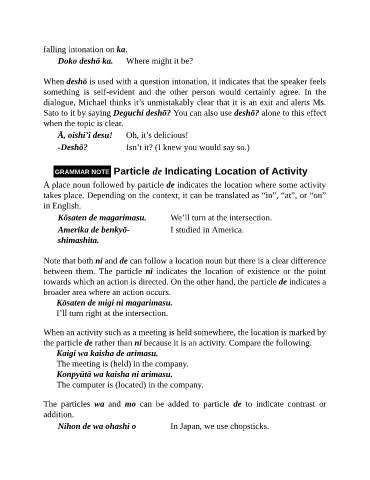
falling intonation on ka.
                    Doko deshō ka.         Where might it be?


               When deshō is used with a question intonation, it indicates that the speaker feels
               something  is  self-evident  and  the  other  person  would  certainly  agree.  In  the
               dialogue, Michael thinks it’s unmistakably clear that it is an exit and alerts Ms.

               Sato to it by saying Deguchi deshō? You can also use deshō? alone to this effect
               when the topic is clear.
                    Ā, oishi’i desu!       Oh, it’s delicious!

                    -Deshō?                Isn’t it? (I knew you would say so.)


                   GRAMMAR NOTE Particle de Indicating Location of Activity


               A place noun followed by particle de indicates the location where some activity
               takes place. Depending on the context, it can be translated as “in”, “at”, or “on”
               in English.
                    Kōsaten de magarimasu.               We’ll turn at the intersection.

                    Amerika de benkyō-                   I studied in America.
                    shimashita.


               Note that both ni and de can follow a location noun but there is a clear difference
               between  them.  The  particle ni  indicates  the  location  of  existence  or  the  point
               towards which an action is directed. On the other hand, the particle de indicates a

               broader area where an action occurs.
                    Kōsaten de migi ni magarimasu.
                    I’ll turn right at the intersection.


               When an activity such as a meeting is held somewhere, the location is marked by
               the particle de rather than ni because it is an activity. Compare the following.
                    Kaigi wa kaisha de arimasu.
                    The meeting is (held) in the company.
                    Konpyūtā wa kaisha ni arimasu.

                    The computer is (located) in the company.


               The  particles  wa  and  mo  can  be  added  to  particle  de  to  indicate  contrast  or
               addition.
                    Nihon de wa ohashi o                 In Japan, we use chopsticks.

