


Page 199 - Easy Japanese - Learn to Speak Japanese Quickly! (TUTTLE)
P. 199
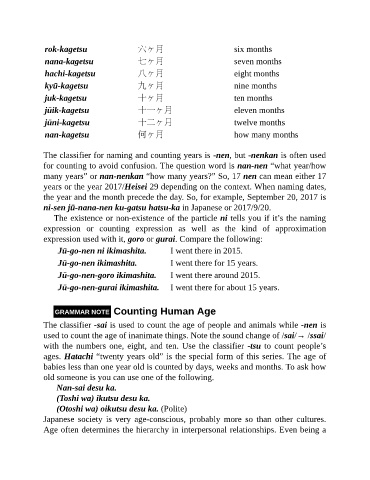
rok-kagetsu                    六ヶ月                            six months
                nana-kagetsu                   七ヶ月                            seven months
                hachi-kagetsu                  八ヶ月                            eight months

                kyū-kagetsu                    九ヶ月                            nine months

                juk-kagetsu                    十ヶ月                            ten months
                jūik-kagetsu                   十一ヶ月                           eleven months

                jūni-kagetsu                   十二ヶ月                           twelve months
                nan-kagetsu                    何ヶ月                            how many months


               The classifier for naming and counting years is -nen, but -nenkan is often used

               for counting to avoid confusion. The question word is nan-nen “what year/how
               many years” or nan-nenkan “how many years?” So, 17 nen can mean either 17
               years or the year 2017/Heisei 29 depending on the context. When naming dates,
               the year and the month precede the day. So, for example, September 20, 2017 is
               ni-sen jū-nana-nen ku-gatsu hatsu-ka in Japanese or 2017/9/20.
                   The existence or non-existence of the particle ni tells you if it’s the naming
               expression  or  counting  expression  as  well  as  the  kind  of  approximation

               expression used with it, goro or gurai. Compare the following:
                    Jū-go-nen ni ikimashita.             I went there in 2015.

                    Jū-go-nen ikimashita.                I went there for 15 years.
                    Jū-go-nen-goro ikimashita.           I went there around 2015.

                    Jū-go-nen-gurai ikimashita.          I went there for about 15 years.


                   GRAMMAR NOTE Counting Human Age

               The classifier -sai is used to count the age of people and animals while -nen is
               used to count the age of inanimate things. Note the sound change of /sai/→ /ssai/

               with the numbers one, eight, and ten. Use the classifier -tsu to count people’s
               ages. Hatachi “twenty years old” is the special form of this series. The age of
               babies less than one year old is counted by days, weeks and months. To ask how
               old someone is you can use one of the following.
                    Nan-sai desu ka.

                    (Toshi wa) ikutsu desu ka.
                    (Otoshi wa) oikutsu desu ka. (Polite)
               Japanese  society  is  very  age-conscious,  probably  more  so  than  other  cultures.
               Age often determines the hierarchy in interpersonal relationships. Even being a

