


Page 243 - Easy Japanese - Learn to Speak Japanese Quickly! (TUTTLE)
P. 243
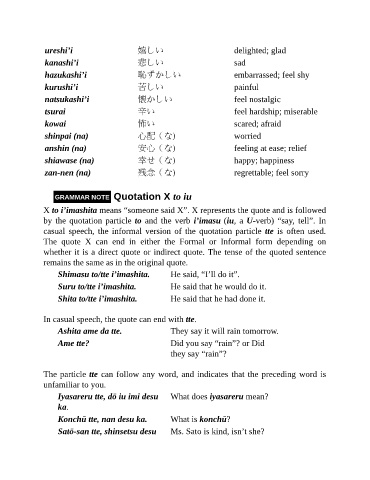
ureshi’i                       嬉しい                            delighted; glad
                kanashi’i                      悲しい                            sad

                hazukashi’i                    恥ずかしい                          embarrassed; feel shy
                kurushi’i                      苦しい                            painful

                natsukashi’i                   懐かしい                           feel nostalgic
                tsurai                         辛い                             feel hardship; miserable

                kowai                          怖い                             scared; afraid
                shinpai (na)                   心配(な)                          worried

                anshin (na)                    安心(な)                          feeling at ease; relief
                shiawase (na)                  幸せ(な)                          happy; happiness

                zan-nen (na)                   残念(な)                          regrettable; feel sorry


                   GRAMMAR NOTE Quotation X to iu

               X to i’imashita means “someone said X”. X represents the quote and is followed
               by the quotation particle to and the verb i’imasu (iu, a U-verb) “say, tell”. In
               casual speech, the informal version of the quotation particle tte is often used.
               The  quote  X  can  end  in  either  the  Formal  or  Informal  form  depending  on
               whether it is a direct quote or indirect quote. The tense of the quoted sentence

               remains the same as in the original quote.
                    Shimasu to/tte i’imashita.           He said, “I’ll do it”.
                    Suru to/tte i’imashita.              He said that he would do it.

                    Shita to/tte i’imashita.             He said that he had done it.


               In casual speech, the quote can end with tte.

                    Ashita ame da tte.                   They say it will rain tomorrow.
                    Ame tte?                             Did you say “rain”? or Did
                                                         they say “rain”?


               The particle tte can follow any word, and indicates that the preceding word is

               unfamiliar to you.
                    Iyasareru tte, dō iu imi desu        What does iyasareru mean?
                    ka.

                    Konchū tte, nan desu ka.             What is konchū?
                    Satō-san tte, shinsetsu desu         Ms. Sato is kind, isn’t she?

