


Page 250 - Easy Japanese - Learn to Speak Japanese Quickly! (TUTTLE)
P. 250
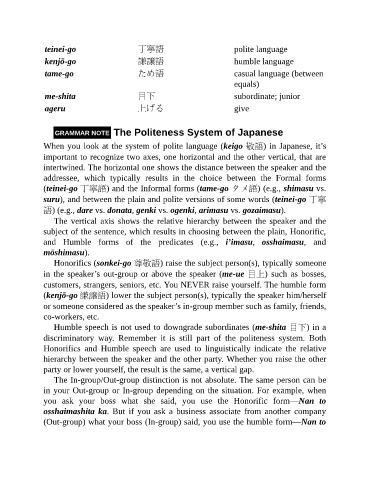
teinei-go                      丁寧語                            polite language
                kenjō-go                       謙譲語                            humble language
                tame-go                        ため語                            casual language (between

                                                                              equals)
                me-shita                       目下                             subordinate; junior

                ageru                          上げる                            give


                   GRAMMAR NOTE The Politeness System of Japanese


               When you look at the system of polite language (keigo 敬語) in Japanese, it’s
               important to recognize two axes, one horizontal and the other vertical, that are
               intertwined. The horizontal one shows the distance between the speaker and the
               addressee,  which  typically  results  in  the  choice  between  the  Formal  forms
               (teinei-go 丁寧語) and the Informal forms (tame-go タメ語) (e.g., shimasu vs.
               suru), and between the plain and polite versions of some words (teinei-go 丁寧

               語) (e.g., dare vs. donata, genki vs. ogenki, arimasu vs. gozaimasu).
                   The vertical axis shows the relative hierarchy between the speaker and the
               subject of the sentence, which results in choosing between the plain, Honorific,
               and  Humble  forms  of  the  predicates  (e.g.,  i’imasu,  osshaimasu,  and
               mōshimasu).

                   Honorifics (sonkei-go 尊敬語) raise the subject person(s), typically someone
               in the speaker’s out-group or above the speaker (me-ue 目上) such as bosses,
               customers, strangers, seniors, etc. You NEVER raise yourself. The humble form
               (kenjō-go 謙譲語) lower the subject person(s), typically the speaker him/herself
               or someone considered as the speaker’s in-group member such as family, friends,

               co-workers, etc.
                   Humble speech is not used to downgrade subordinates (me-shita 目下) in a
               discriminatory  way.  Remember  it  is  still  part  of  the  politeness  system.  Both
               Honorifics  and  Humble  speech  are  used  to  linguistically  indicate  the  relative
               hierarchy between the speaker and the other party. Whether you raise the other

               party or lower yourself, the result is the same, a vertical gap.
                   The In-group/Out-group distinction is not absolute. The same person can be
               in your Out-group or In-group depending on the situation. For example, when
               you  ask  your  boss  what  she  said,  you  use  the  Honorific  form—Nan  to
               osshaimashita ka. But if you ask a business associate from another company
               (Out-group) what your boss (In-group) said, you use the humble form—Nan to

