


Page 43 - Easy Japanese - Learn to Speak Japanese Quickly! (TUTTLE)
P. 43
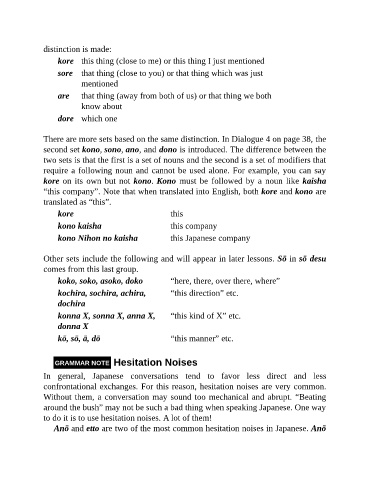
distinction is made:
                    kore this thing (close to me) or this thing I just mentioned
                    sore that thing (close to you) or that thing which was just

                            mentioned
                    are     that thing (away from both of us) or that thing we both
                            know about

                    dore which one


               There are more sets based on the same distinction. In Dialogue 4 on page 38, the
               second set kono, sono, ano, and dono is introduced. The difference between the
               two sets is that the first is a set of nouns and the second is a set of modifiers that
               require a following noun and cannot be used alone. For example, you can say

               kore on its own but not kono. Kono must be followed by a noun like kaisha
               “this company”. Note that when translated into English, both kore and kono are
               translated as “this”.
                    kore                                 this

                    kono kaisha                          this company
                    kono Nihon no kaisha                 this Japanese company


               Other sets include the following and will appear in later lessons. Sō in sō desu
               comes from this last group.
                    koko, soko, asoko, doko              “here, there, over there, where”

                    kochira, sochira, achira,            “this direction” etc.
                    dochira
                    konna X, sonna X, anna X,            “this kind of X” etc.

                    donna X
                    kō, sō, ā, dō                        “this manner” etc.


                   GRAMMAR NOTE Hesitation Noises

               In  general,  Japanese  conversations  tend  to  favor  less  direct  and  less
               confrontational exchanges. For this reason, hesitation noises are very common.
               Without them, a conversation may sound too mechanical and abrupt. “Beating
               around the bush” may not be such a bad thing when speaking Japanese. One way

               to do it is to use hesitation noises. A lot of them!
                   Anō and etto are two of the most common hesitation noises in Japanese. Anō

