


Page 71 - All About History - Issue 38-16
P. 71
Celts: Cult of Death


                                                                                                Did druids
                                                                                                practise human
                                                                                                sacrifice?

                                                                                                Dr Andrew Jennings, UHI
                                                                                                Centre for Nordic Studies
                                                                                                                  There is no reason
                                                                                                                  to doubt Caesar’s
                                                                                                                  claim that the
                                                                                                                  druids carried out
                                                                                                                  human sacrifice.
                                                                                                                  Life was offered to
                                                                                                                  the gods in return
                                                                                                                  for life. So someone
                                                                                                                  afflicted with a
                                                                                                                  serious disease or
                                                                                                                  a warrior fighting
                                                                                                a battle would offer a human sacrifice in
                                                                                                return for their life, and the druids would
                                                                                                carry it out. An animal was no substitute
                                                                                                and criminals were pleasing to the gods, but
                                                                                                if they were in short supply, the innocent
                                                                                                would do. However, we don’t know what
                                                                                                the Celtic gods wanted the spirits of the
                                                                                                sacrificed for.
                                                                                                  Caesar also tells us about that most
                                                                                                gruesome of sacrifice the Wicker Man, where
                                                                                                an immense statue of twigs was filled with
                                                                                                victims and set alight. He also remarks that
                                                                                                druidism originated in Britain, so it’s no
                                                                                                surprise to hear from Tacitus that blood-
                                                                                                soaked altars existed among the British Celts.
                                                                                                Further afield, the Galatians, a Celtic people
                                                                                                who settled in Turkey, reportedly sacrificed
                                                                                                their prisoners after a battle in 165 BCE. The
                                                                                                Celts were not odd for carrying out human
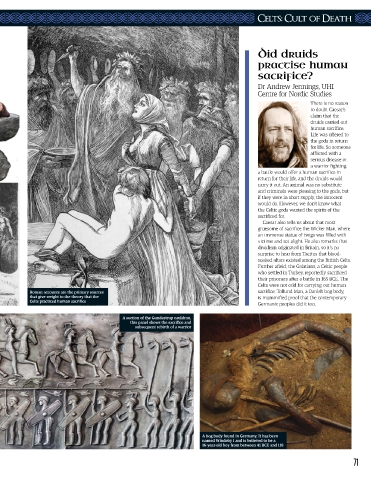
                Roman accounts are the primary sources                                          sacrifice. Tollund Man, a Danish bog body,
                that give weight to the theory that the                                         is mummified proof that the contemporary
                Celts practiced human sacrifice
                                                                                                Germanic peoples did it too.
                                                A section of the Gundestrup cauldron,
                                                   this panel shows the sacrifice and
                                                     subsequent rebirth of a warrior


                                                                            A bog body found in Germany. It has been
                                                                            named Windeby I and is believed to be a
                                                                            16-year-old boy from between 41 BCE and 118


                                                                                                                                  71


       066-073_AAH38_Celts of Death.indd   71                                                                                13/04/2016   23:38

