


Page 73 - All About History - Issue 38-16
P. 73
Celts: Cult of Death
eltic funerals were held in areas
What happened to the Celts? that were considered sacred, like
Celtic culture disintegrated during and after the end of the Roman woodland groves and natural
Empire. Germanic tribes ransacked the dwindling empire and the Celts springs. The Iron Age is when
were forced to retreat to small pockets of Ireland, Scotland, Wales and Cwe begin to find evidence for the
Brittany in France. The Roman Catholic Church had a huge say in the burial of ordinary people. Prior to this, burial was
dissolution and memory of Celtic culture. Druidism is believed to have reserved for the elite, who were placed in elaborate
left the history books by approximately 700 before continuing briey
underground. When Catholicism took over the British Isles, pagan sites tombs rather than the hole-in-the-ground graves
were turned into cathedrals and the pagan gods were either forgotten that became the norm during the Celtic period.
or became associated with saints. Breton, Manx, Welsh and Erse Gaelic Many Celts, both on the continent and in
languages still survive in areas of the British Isles and Europe in some way,
ensuring that the traditional customs and culture of the Celts lives on. Britain, embraced the new Roman culture thrust
upon them, initiating what was known as the
Gallo-Roman period. This had effects on funeral
ceremonies, which were now undertaken in
temples known as ‘fanums’ built on sacred ground.
These culture differences, plus the fact that the
Celts were not a centralised society, means Celtic
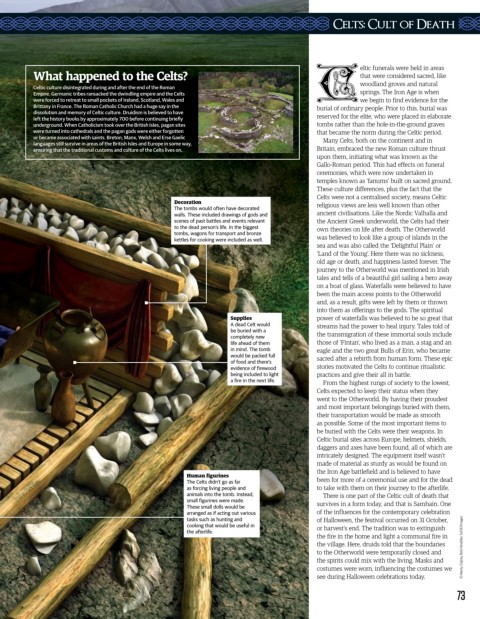
Decoration religious views are less well known than other
The tombs would often have decorated
walls. These included drawings of gods and ancient civilisations. Like the Nordic Valhalla and
scenes of past battles and events relevant the Ancient Greek underworld, the Celts had their
to the dead person’s life. In the biggest own theories on life after death. The Otherworld
tombs, wagons for transport and bronze
kettles for cooking were included as well. was believed to look like a group of islands in the
sea and was also called the ‘Delightful Plain’ or
‘Land of the Young’. Here there was no sickness,
old age or death, and happiness lasted forever. The
journey to the Otherworld was mentioned in Irish
tales and tells of a beautiful girl sailing a hero away
on a boat of glass. Waterfalls were believed to have
been the main access points to the Otherworld
and, as a result, gifts were left by them or thrown
into them as offerings to the gods. The spiritual
Supplies power of waterfalls was believed to be so great that
A dead Celt would streams had the power to heal injury. Tales told of
be buried with a the transmigration of these immortal souls include
completely new
life ahead of them those of ‘Fintan’, who lived as a man, a stag and an
in mind. The tomb eagle and the two great Bulls of Erin, who became
would be packed full sacred after a rebirth from human form. These epic
of food and there’s
evidence of firewood stories motivated the Celts to continue ritualistic
being included to light practices and give their all in battle.
a fire in the next life. From the highest rungs of society to the lowest,
Celts expected to keep their status when they
went to the Otherworld. By having their proudest
and most important belongings buried with them,
their transportation would be made as smooth
as possible. Some of the most important items to
be buried with the Celts were their weapons. In
Celtic burial sites across Europe, helmets, shields,
daggers and axes have been found, all of which are
intricately designed. The equipment itself wasn’t
made of material as sturdy as would be found on
the Iron Age battlefield and is believed to have
Human figurines
The Celts didn’t go as far been for more of a ceremonial use and for the dead
as forcing living people and to take with them on their journey to the afterlife.
animals into the tomb. Instead, There is one part of the Celtic cult of death that
small figurines were made. survives in a form today, and that is Samhain. One
These small dolls would be
arranged as if acting out various of the influences for the contemporary celebration
tasks such as hunting and of Halloween, the festival occurred on 31 October,
cooking that would be useful in or harvest’s end. The tradition was to extinguish
the afterlife.
the fire in the home and light a communal fire in
the village. Here, druids told that the boundaries © Alamy, Osprey, Bob Venables, Sol 90 Images
to the Otherworld were temporarily closed and
the spirits could mix with the living. Masks and
costumes were worn, influencing the costumes we
see during Halloween celebrations today.
73
066-073_AAH38_Celts of Death.indd 73 13/04/2016 22:14

