


Page 309 - (DK) The Ultimate Visual Dictionary 2nd Ed.
P. 309
THE VARIETY OF MATTER


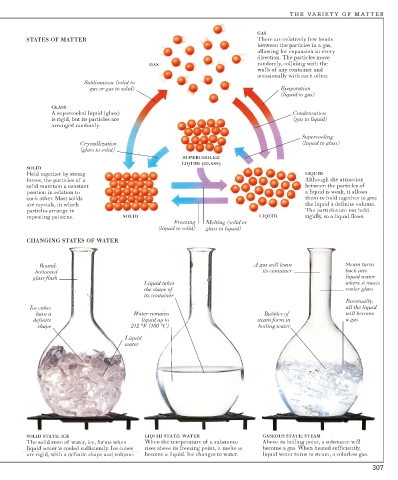
                                                                         GAS
        STATES OF MATTER                                                 There are relatively few bonds
                                                                         between the particles in a gas,
                                                                         allowing for expansion in every
                                                                         direction. The particles move
                                           GAS                           randomly, colliding with the
                                                                         walls of any container and
                                                                         occasionally with each other.
                        Sublimation (solid to
                          gas or gas to solid)                                 Evaporation
                                                                               (liquid to gas)
               GLASS
               A supercooled liquid (glass)                                       Condensation
               is rigid, but its particles are                                    (gas to liquid)
               arranged randomly.
                                                                                     Supercooling
                       Crystallization                                               (liquid to glass)
                       (glass to solid)
                                                    SUPERCOOLED
                                                   LIQUID (GLASS)
        SOLID
        Held together by strong                                                       LIQUID
        forces, the particles of a                                                    Although the attraction
        solid maintain a constant                                                     between the particles of
        position in relation to                                                       a liquid is weak, it allows
        each other. Most solids                                                       them to hold together to give
        are crystals, in which                                                        the liquid a definite volume.
        particles arrange in                                                          The particles are not held
        repeating patterns.        SOLID                                 LIQUID       rigidly, so a liquid flows.
                                                 Freezing   Melting (solid or
                                             (liquid to solid)  glass to liquid)
        CHANGING STATES OF WATER


            Round-                                                      A gas will leave         Steam turns
           bottomed                                                       its container          back into
          glass flask                                                                            liquid water
                                         Liquid takes                                            where it meets
                                         the shape of                                            cooler glass
                                         its container
                                                                                                 Eventually,
         Ice cubes                                                                               all the liquid
           have a                     Water remains                       Bubbles of             will become
          definite                      liquid up to                    steam form in            a gas
           shape                     212 °F (100 °C)                     boiling water
                                    Liquid
                                    water


        SOLID STATE: ICE                 LIQUID STATE: WATER              GASEOUS STATE: STEAM
        The solid state of water, ice, forms when   When the temperature of a substance   Above its boiling point, a substance will
        liquid water is cooled sufficiently. Ice cubes   rises above its freezing point, it melts to   become a gas. When heated sufficiently,
        are rigid, with a definite shape and volume.  become a liquid. Ice changes to water.  liquid water turns to steam, a colorless gas.

                                                                                                        307

