


Page 312 - (DK) The Ultimate Visual Dictionary 2nd Ed.
P. 312
PHYSICS AND CHEMISTR Y
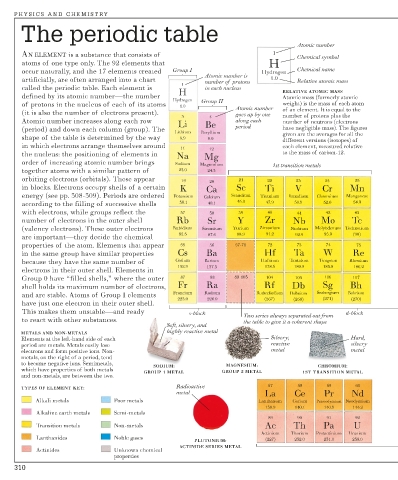
       The periodic table


                                                                                    Atomic number
       AN ELEMENT is a substance that consists of                            1      Chemical symbol
       atoms of one type only. The 92 elements that                         H
       occur naturally, and the 17 elements created   Group I             Hydrogen  Chemical name
                                                          Atomic number is
       artificially, are often arranged into a chart      number of  protons   1.0  Relative atomic mass
                                                   1
       called the periodic table. Each element is   H     in each nucleus       RELATIVE ATOMIC MASS
       defined by its atomic number—the number                                  Atomic mass (formerly atomic
                                                 Hydrogen  Group II
       of protons in the nucleus of each of its atoms   1.0       Atomic number   weight) is the mass of each atom
       (it is also the number of electrons present).              goes up by one   of an element. It is equal to the
                                                   3       4                    number of protons plus the
       Atomic number increases along each row     Li      Be      along each    number of neutrons (electrons
       (period) and down each column (group). The                 period        have negligible mass). The figures
                                                  Lithium  Beryllium            given are the averages for all the
       shape of the table is determined by the way   6.9   9.0
                                                                                different versions (isotopes) of
       in which electrons arrange themselves around   11   12                   each element, measured relative
       the nucleus: the positioning of elements in   Na   Mg                    to the mass of carbon-12.
       order of increasing atomic number brings   Sodium  Magnesium          1st transition metals
       together atoms with a similar pattern of    23.0    24.3
       orbiting electrons (orbitals). These appear   19    20      21      22      23      24       25
       in blocks. Electrons occupy shells of a certain   K  Ca     Sc      Ti      V       Cr     Mn
       energy (see pp. 308-309). Periods are ordered   Potassium  Calcium  Scandium  Titanium  Vanadium  Chromium  Manganese
       according to the filling of successive shells   39.1  40.1  45.0    47.9    50.9    52.0    54.9
       with electrons, while groups reflect the    37      38      39      40       41     42       43
       number of electrons in the outer shell     Rb       Sr      Y       Zr     Nb      Mo       Tc
       (valency electrons). These outer electrons   Rubidium  Strontium  Yttrium  Zirconium  Niobium  Molybdenum Technetium
       are important—they decide the chemical      85.5    87.6    88.9    91.2    92.9    95.9    (98)
       properties of the atom. Elements that appear   55   56     57-71    72      73       74      75
       in the same group have similar properties   Cs     Ba              Hf       Ta      W       Re
       because they have the same number of       Cesium  Barium          Hafnium  Tantalum  Tungsten  Rhenium
                                                  132.9   137.3            178.5   180.9   183.8   186.2
       electrons in their outer shell. Elements in
       Group 0 have “filled shells,” where the outer   87  88     89-103   104     105     106     107
       shell holds its maximum number of electrons,  Fr   Ra              Rf      Db       Sg     Bh
       and are stable. Atoms of Group I elements   Francium  Radium     Rutherfordium  Dubnium  Seaborgium  Bohrium
                                                  223.0    226.0          (267)    (268)   (271)   (270)
       have just one electron in their outer shell.
       This makes them unstable—and ready            s-block         Two series always separated out from   d-block
       to react with other substances.                               the table to give it a coherent shape
                                               Soft, silvery, and
                                               highly reactive metal
       METALS AND NON-METALS
       Elements at the left-hand side of each                               Silvery,              Hard,
       period are metals. Metals easily lose                                reactive              silvery
       electrons and form positive ions. Non-                               metal                 metal
       metals, on the right of a period, tend
       to become negative ions. Semimetals,   SODIUM:           MAGNESIUM:               CHROMIUM:
       which have properties of both metals   GROUP 1 METAL    GROUP 2 METAL         1ST TRANSITION METAL
       and non-metals, are between the two.
       TYPES OF ELEMENT KEY:                      Radioactive              57       58      59      60
                                                  metal                    La      Ce      Pr      Nd
           Alkali metals         Poor metals                             Lanthanum  Cerium  Praseodymium Neodymium
                                                                           138.9   140.1   140.9   144.2
           Alkaline earth metals  Semi-metals
                                                                            89      90      91      92
           Transition metals     Non-metals                                Ac      Th      Pa      U
                                                                          Actinium  Thorium  Protactinium  Uranium
           Lanthanides           Noble gases                               (227)   232.0   231.0   238.0
                                                       PLUTONIUM:
                                                   ACTINIDE SERIES METAL
           Actinides             Unknown chemical
                                 properties
     310

