


Page 310 - (DK) The Ultimate Visual Dictionary 2nd Ed.
P. 310
PHYSICS AND CHEMISTR Y

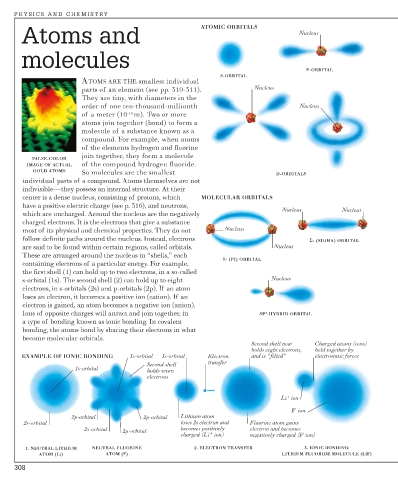
       Atoms and                                         ATOMIC ORBITALS            Nucleus


       molecules

                                                                                      P-ORBITAL
                                                              S-ORBITAL
                        ATOMS ARE THE smallest individual
                        parts of an element (see pp. 310-311).          Nucleus
                        They are tiny, with diameters in the
                        order of one ten-thousand-millionth                         Nucleus
                        of a meter (10 m). Two or more
                                    -10
                        atoms join together (bond) to form a
                        molecule of a substance known as a
                        compound. For example, when atoms
                        of the elements hydrogen and fluorine
                        join together, they form a molecule
          FALSE-COLOR
        IMAGE OF ACTUAL   of the compound hydrogen fluoride.
          GOLD ATOMS    So molecules are the smallest                         D-ORBITALS
       individual parts of a compound. Atoms themselves are not
       indivisible—they possess an internal structure. At their
       center is a dense nucleus, consisting of protons, which    MOLECULAR ORBITALS
       have a positive electric charge (see p. 316), and neutrons,
                                                                               Nucleus          Nucleus
       which are uncharged. Around the nucleus are the negatively
       charged electrons. It is the electrons that give a substance
       most of its physical and chemical properties. They do not   Nucleus
       follow definite paths around the nucleus. Instead, electrons                    Σ- (SIGMA) ORBITAL
       are said to be found within certain regions, called orbitals.         Nucleus
       These are arranged around the nucleus in “shells,” each
                                                               π- (PI) ORBITAL
       containing electrons of a particular energy. For example,
       the first shell (1) can hold up to two electrons, in a so-called
       s-orbital (1s). The second shell (2) can hold up to eight            Nucleus
       electrons, in s-orbitals (2s) and p-orbitals (2p). If an atom
       loses an electron, it becomes a positive ion (cation). If an
       electron is gained, an atom becomes a negative ion (anion).
       Ions of opposite charges will attract and join together, in       SP -HYBRID ORBITAL
                                                                           3
       a type of bonding known as ionic bonding. In covalent
       bonding, the atoms bond by sharing their electrons in what
       become molecular orbitals.
                                                                       Second shell now   Charged atoms (ions)
                                                                       holds eight electrons,   held together by
       EXAMPLE OF IONIC BONDING      1s-orbital  1s-orbital  Electron   and is “filled”                 electrostatic forces
                                                           transfer
                                          Second shell
                      1s-orbital          holds seven
                                          electrons


                                                                               Li +  ion
                                                                                  F -  ion
                     2p-orbital          2p-orbital  Lithium atom
        2s-orbital                                 loses 2s electron and   Fluorine atom gains
                        2s-orbital  2p-orbital     becomes positively   electron and becomes
                                                           +
                                                   charged (Li  ion)  negatively charged (F -  ion)
        1. NEUTRAL LITHIUM   NEUTRAL FLUORINE          2. ELECTRON TRANSFER           3. IONIC BONDING:
            ATOM (Li)         ATOM (F)                                         LITHIUM FLUORIDE MOLECULE (LiF)
     308

