


Page 314 - (DK) The Ultimate Visual Dictionary 2nd Ed.
P. 314
PHYSICS AND CHEMISTR Y

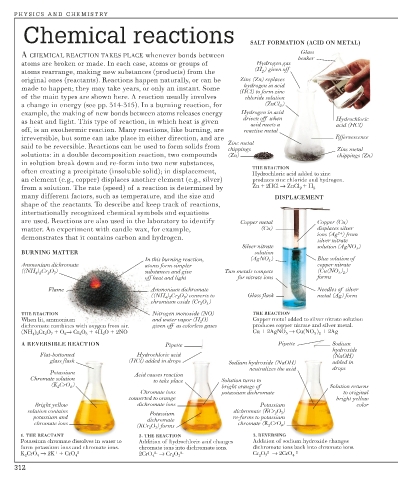
       Chemical reactions                                              SALT FORMATION (ACID ON METAL)


                                                                                     Glass
       A CHEMICAL REACTION TAKES PLACE whenever bonds between
                                                                                    beaker
       atoms are broken or made. In each case, atoms or groups of       Hydrogen gas
                                                                        (H 2  ) given off
       atoms rearrange, making new substances (products) from the
       original ones (reactants). Reactions happen naturally, or can be   Zinc (Zn) replaces
                                                                     hydrogen in acid
       made to happen; they may take years, or only an instant. Some
                                                                   (HCl) to form zinc
       of the main types are shown here. A reaction usually involves   chloride solution
       a change in energy (see pp. 314-315). In a burning reaction, for    (ZnCl 2  )
       example, the making of new bonds between atoms releases energy   Hydrogen in acid
                                                                     driven off  when         Hydrochloric
       as heat and light. This type of reaction, in which heat is given
                                                                       acid meets a           acid (HCl)
       off, is an exothermic reaction. Many reactions, like burning, are   reactive metal
       irreversible, but some can take place in either direction, and are                     Effervescence
       said to be reversible. Reactions can be used to form solids from   Zinc metal
                                                                chippings                      Zinc metal
       solutions: in a double decomposition reaction, two compounds   (Zn)                     chippings (Zn)
       in solution break down and re-form into two new substances,
                                                                       THE REACTION
       often creating a precipitate (insoluble solid); in displacement,   Hydrochloric acid added to zinc
       an element (e.g., copper) displaces another element (e.g., silver)   produces zinc chloride and hydrogen.
       from a solution. The rate (speed) of a reaction is determined by   Zn + 2HCl → ZnCl 2  + H 2
       many different factors, such as temperature, and the size and         DISPLACEMENT
       shape of the reactants. To describe and keep track of reactions,
       internationally recognized chemical symbols and equations
       are used. Reactions are also used in the laboratory to identify   Copper metal    Copper (Cu)
       matter. An experiment with candle wax, for example,               (Cu)            displaces silver
                                                                                         ions (Ag 2+ ) from
       demonstrates that it contains carbon and hydrogen.
                                                                                         silver nitrate
                                                                    Silver nitrate       solution (AgNO 3  )
       BURNING MATTER                                                   solution
                                         In this burning reaction,    (AgNO 3  )         Blue solution of
       Ammonium dichromate               atoms form simpler                              copper nitrate
       ((NH 4 ) 2 Cr 2 O 7 )             substances and give   Two metals compete        (Cu(NO 3  ) 2  )
                                         off heat and light        for nitrate ions      forms
              Flame                        Ammonium dichromate                           Needles of  silver
                                           ((NH 4 ) 2 Cr 2 O 7 ) converts to   Glass flask  metal (Ag) form
                                           chromium oxide (Cr 2 O 3  )
       THE REACTION                        Nitrogen monoxide (NO)      THE REACTION
       When lit, ammonium                  and water vapor (H 2 O)     Copper metal added to silver nitrate solution
       dichromate combines with oxygen from air.   given off  as colorless gases  produces copper nitrate and silver metal.
       (NH 4 ) 2 Cr 2 O 7  + O 2 → Cr 2 O 3  + 4H 2 O + 2NO            Cu + 2AgNO 3  → Cu(NO 3  ) 2  + 2Ag
       A REVERSIBLE REACTION                   Pipette                        Pipette        Sodium
                                                                                             hydroxide
            Flat-bottomed              Hydrochloric acid                                     (NaOH)
               glass flask           (HCl) added in drops        Sodium hydroxide (NaOH)     added in
                                                                      neutralizes the acid   drops
               Potassium              Acid causes reaction
         Chromate solution                  to take place      Solution turns to
               (K 2 CrO 4  )                                   bright orange of              Solution returns
                                        Chromate ions          potassium dichromate             to original
                                     converted to orange                                      bright yellow
           Bright yellow               dichromate ions                   Potassium                  color
         solution contains                 Potassium              dichromate (KCr O 7 )
                                                                             2
          potassium and                   dichromate              re-forms to potassium
           chromate ions                                           chromate (K 2 CrO 4 )
                                       (KCr 2 O 7 ) forms
       1. THE REACTANT                  2. THE REACTION                3. REVERSING
       Potassium chromate dissolves in water to   Addition of hydrochloric acid changes   Addition of sodium hydroxide changes
       form potassium ions and chromate ions.   chromate ions into dichromate ions.   dichromate ions back into chromate ions.
                      2-                    2-     2-                  Cr 2 O 7  → 2CrO 4   2-
                                                                           2-
       K 2 CrO 4  → 2K +  + CrO 4       2CrO 4  → Cr 2 O 7
     312

