


Page 55 - History of War - Issue 18-15
P. 55
THE FORGOTTEN SIKH REGIMENTS OF THE BRITISH EMPIRE


                                                        THEANGLO-SIKHWARS

                                                   THE END OF THE SIKH KINGDOM AND THE BEGINNING OF BRITISH CO-OPERATION
                                                   By the time of the First Anglo-Sikh War in  1848,whichlastedalmostayearbeforeasecond
                                                   1845, the majority of the Indian subcontinent  andfinaldefeatfortheSikhs.Withoutamilitaryof
                                                   was under the controloftheBritishEastIndia  their own, the Sikh soldiers soon joined the British
                                                   Company. Upon the death of Maharaja Ranjit  Armyinsearchofacareerinthearmedforces.
                                                   Singh in 1839,
                                                   disjointed and s
                                                   confl icts. When
                                                   empire’s frontie
                                                   invaders had de
                                                   of the Punjab. B
                                                   assembled a fo
                                                   men and 60 gu
                                                     War was dec
                                                   against the Sik
                                                   Khalsa Army af
                                                   they crossed th
                                                   Sutlej. Ranjit Si
                                                   left a modernis
                                                   disciplined arm
                                                   to low morale a
                                                   they were no m
                                                   It is without dou
                                                   lost by the egoc
                                                   commanders ra
                                                   British rout. Th
                                                   took over the a
                                                   of the region un
                                                   Treaty of Lahor
                                                   but resentment
                                                   to this new rule
                                                   led to the Seco
                                                   Anglo-Sikh War

              The Punjab Frontier Force was set up and
            comprised the 1st, 2nd (Hill), 3rd and 4th   SIKHSOFTHESOMME
            Regiments of infantry as well as cavalry units.
            Acting primarily as rapid-response regiments,   THEREGIMENTSWHOFOUGHTINONEOFTHEBLOODIESTBATTLESOFTHEWAR
            they would patrol the British borders in   TheBritishSikhregimentsfoughtalloverFrancefortheTripleEntente,includinginYpres,Neuve
            search of any Afghan aggression. The Sikhs   Chapelleandthe1916BattleoftheSomme.Facedwithgasattacks,disease,machinegunsandthe
            displayed great bravery during the war and   mud of the trenches, the fields of France were a world away from the peaceful plains of the Punjab.
            were employed effectively at both Ahmed Khel   Two Indian regiments even took part in the notorious High Wood cavalry assault, the only charge of
            and Kandahar towards the end of the confl ict   thebattle.Sikhsalsoformedateamofbicycledespatchriders,traversingFricourtandtheMametz
            in 1880. Their courage and dedication was   Road near to the battlefield.
            admired by the British and would be utilised to   ThelossoflifeamongtheunitswassohighthatbythelatterstagesofthewartheIndian
            greater effect in future campaigns.    regiments were relocated to the Middle East, where they were closer to India and easier to reinforce
              A British victory came in 1880, but the war   andsupply.ASikhsoldier,IndarSingh,fightingattheSommeinSeptember1916,wrotehome:“It
            was now more than just an Anglo-Afghan affair,   isquiteimpossiblethatIshouldreturnalive.[But]don’tbegrievedatmydeath,becauseIshalldie
            as Russia waded into the confl ict. A period   arms in hand, wearing the warrior’s clothes. Thisisthemosthappydeaththatanyonecandie.”
            known as the ‘Great Game’ was initiated, and
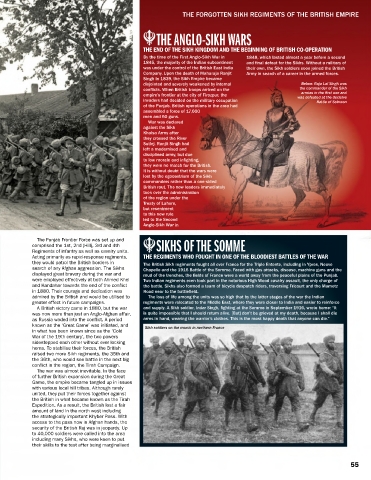
                                                    Sikh soldiers on the march in northern France
            in what has been known since as the ‘Cold
            War of the 19th century’, the two powers
            sidestepped each other without ever locking
            horns. To stabilise their forces, the British
            raised two more Sikh regiments, the 35th and
            the 36th, who would see battle in the next big
            confl ict in the region, the Tirah Campaign.
              The war was almost inevitable. In the face
            of further British expansion during the Great
            Game, the empire became tangled up in issues
            with various local hill tribes. Although rarely
            united, they put their forces together against
            the British in what became known as the Tirah
            Expedition. As a result, the British lost a fair
            amount of land in the north west including
            the strategically important Khyber Pass. With
            access to the pass now in Afghan hands, the
            security of the British Raj was in jeopardy. Up
            to 40,000 soldiers were called into the area
            including many Sikhs, who were keen to put
            their skills to the test after being marginalised


                                                                                                                            55

