


Page 50 - History of War - Issue 18-15
P. 50
THE BOW THAT BUILT BRITAIN


          THEAGEOFTHELONGBOW


          ONEOFTHEMOSTREVOLUTIONARYWEAPONSOFITSAGE,THELONGBOWHELPEDTHEENGLISHCUTASWATHETHROUGHFRANCE
          The longbow helped to shape what became the  shot their arrows with such force and quickness   arrows were best for piercing a soldier’s plate
          Englishwayofwar:smallmobilearmiesmadeup  that it seems as if it snowed.”   armour. These pointed tips could stab deep
          of knights, men-at-arms and, most importantly,  English archers first made their name at   into fl esh, and lacerated the victim’s tissue with
          archers, who could march and fight at a moment’s  the Battle of Falkirk, destroying the tightly   their every movement. Broad-headed arrows,
          notice. Throughout the Hundred Years’ War  packed Scottish schiltrons. But the Battle of   meanwhile, could create hideously painful
          betweenFranceandEngland,thelongbowmen  Bannockburn, in 1314, demonstrated how   wounds and were diffi cult to remove even for
          proved their worth. A skilled archer was able to  vulnerable archers were to cavalry when Scottish  trained surgeons.
          looseuptoeightarrowsperminuteandstrike  horses outflanked them. This became a pattern,   Crucially for a war economy, the war bow was
          anenemymorethan200metresaway.Inorder  with archers often proving decisive when they   cheap to make, lightweight and versatile. Even
          to master the longbow and become an archer,  were expertly deployed, as at Neville’s Cross   as late as 1545, Henry VIII’s fl agship, the Mary
          both strength and skill were required. Hours of  in 1346 and Aljubarrota in 1385, or when they   Rose, carried more than 200 longbows and
          dailypracticeatthe‘butts’wereneeded,andby  were well protected either by stakes as at   thousands of arrows.
          1369thecallfortrainedarchershadbecomeso  Agincourtorbymen-at-armsas at Crecy.   The Battle of Pinkie Cleugh, in 1547, marked
          important that Edward III decreed all sports were  Their weaknesses were revealed, however,   one of the last times the longbow was used in a
          to be banned and all able-bodied men were to  when they were caught in the open at Verneuil   major battle, with both the English and Scottish
          practise their archery instead.      and Patay or were lured away from their   armies fi elding several thousand archers.
           Inbattle,anarcherwouldhavetofireasfast  defensive positions. At Formigny, in 1450,   While the archers did not play the pivotal role
          andconsistentlyashecould,oftenwithhislife  they were left vulnerable and were cut down   that they had in earlier battles, they fought
          dependingonit.AFrenchchronicleoftheBattle  mercilesslybyenemycavalry.      alongside Henry VIII’s most modern gunpowder
          ofCrecyevenrecalledthat“theEnglisharchers…  The typical 130 to 150-pound draw-weight   weapons – cannons and arquebuses.
                                               ofawarbowenabledittopenetrate a knight’s   Despite the dawning of the gunpowder age,
          “THROUGHOUTTHEHUNDRED                plate armour at about 60 yards. Archers used   archers continued to be part of English armies
                                                                                     during Elizabeth I’s reign, with longbowmen
                                               a variety of arrows, from sharply pointed and
          YEARS’WARBETWEENFRANCE               hardened arrowheads to incendiary arrows and   among the trained bands that prepared to meet
                                                                                     the Spanish Armada’s invasion force in 1588.
                                               broad-headed swallowtail points, which were
          ANDENGLAND,THELONGBOWMEN             difficult to remove.
                                                 Long needle-like bodkins were the best
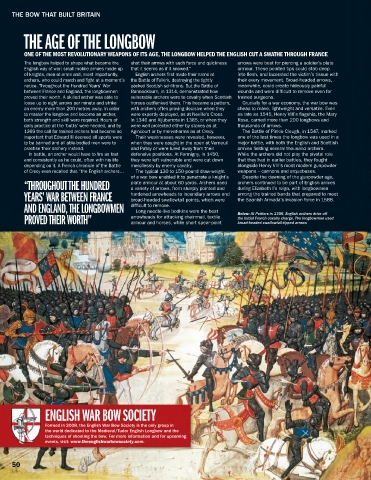
          PROVEDTHEIRWORTH”                    arrowheads for attacking chainmail, textile   Below: At Poitiers in 1356, English archers drive off
                                                                                     the initial French cavalry charge. The longbowmen used
                                               armour and horses, while short spear-point
                                                                                     broad-headed swallowtail-tipped arrows


                 ENGLISH WAR BOW SOCIETY


                 Formed in 2008, the English War Bow Society is the only group in
                 the world dedicated to the Medieval/Tudor English Longbow and the
                 techniques of shooting the bow. For more information and for upcoming
                 events, visit: www.theenglishwarbowsociety.com.


     50

