


Page 53 - History of War - Issue 18-15
P. 53
THE FORGOTTEN

                                                          Sikh


                                                                                OF THE
                                                  British Empire


                                                                                WORDS JACK GRIFFITHS

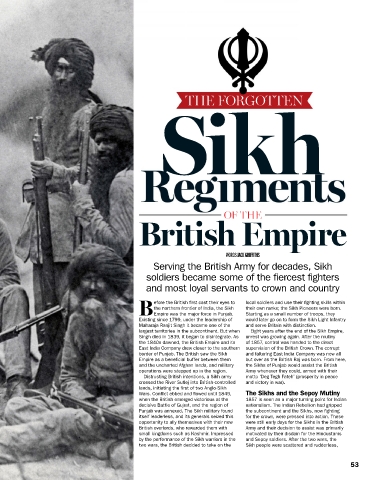
                                                       Serving the British Army for decades, Sikh
                                                    soldiers became some of the fiercest fighters
                                                    and most loyal servants to crown and country


                                                       efore the British first cast their eyes to   local soldiers and use their fighting skills within
                                                       the northern frontier of India, the Sikh   their own ranks; the Sikh Pioneers were born.
                                                  BEmpire was the major force in Punjab.   Starting as a small number of troops, they
                                                  Existing since 1799, under the leadership of   would later go on to form the Sikh Light Infantry
                                                  Maharaja Ranjit Singh it became one of the   and serve Britain with distinction.
                                                  largest territories in the subcontinent. But when  Eight years after the end of the Sikh Empire,
                                                  Singh died in 1839, it began to disintegrate. As  unrest was growing again. After the mutiny
                                                  the 1840s dawned, the British Empire and its   of 1857, control was handed to the direct
                                                  East India Company drew closer to the southern  supervision of the British Crown. The corrupt
                                                  border of Punjab. The British saw the Sikh   and faltering East India Company was now all
                                                  Empire as a beneficial buffer between them   but over as the British Raj was born. From here,
                                                  and the uncharted Afghan lands, and military   the Sikhs of Punjab would assist the British
                                                  operations were stepped up in the region.   Army whenever they could, armed with their
                                                    Distrusting British intentions, a Sikh army   motto ‘Deg Tegh Fateh’ (prosperity in peace
                                                  crossed the River Sutlej into British-controlled   and victory in war).
                                                  lands, initiating the first of two Anglo-Sikh
                                                  Wars. Conflict ebbed and flowed until 1849,   The Sikhs and the Sepoy Mutiny
                                                  when the British emerged victorious at the   1857 is seen as a major turning point for Indian
                                                  decisive Battle of Gujrat, and the region of   nationalism. The Indian Rebellion had gripped
                                                  Punjab was annexed. The Sikh military found   the subcontinent and the Sikhs, now fighting
                                                  itself leaderless, and its generals seized this   for the crown, were pressed into action. These
                                                  opportunity to ally themselves with their new   were still early days for the Sikhs in the British
                                                  British overlords, who rewarded them with   Army and their decision to assist was primarily
                                                  small kingdoms such as Kashmir. Impressed   motivated by their disdain for the Hindustanis
                                                  by the performance of the Sikh warriors in the   and Sepoy soldiers. After the two wars, the
                                                  two wars, the British decided to take on the   Sikh people were scattered and rudderless,


                                                                                                                            53

