


Page 51 - History of War - Issue 18-15
P. 51
THE BOW THAT BUILT BRITAIN

            MILITARY ARROWHEADS OF THE                                         LONGBOWVSCROSSBOW
                                                                              ThearrowheadsshownaremadebyMiloslavLaskyKrizanandHectorColeMBE

            MEDIEVAL PERIOD                                                    GREATRIVALSOFTHEIRAGE,THELONGBOWAND

                                                                               CROSSBOW HAD THEIR MOST FAMOUS CLASH IN
                                                                               1346INAVALLEYINNORTHERNFRANCE
            TAKE A CLOSER LOOK AT MEDIEVAL ARROWHEADS AND FIND OUT HOW EACH
            WAS MADE AND USED                                                  Likethelongbow,thecrossbowwasfirstusedforhunting,
                                                                               but in time it evolved into a deadly weapon of war. The
                                                                               crossbow’s greatest strengths were its superior power and
                                                                               relative ease of use, enabling crossbowmen to train in
                                                                               days rather than the years it took for an archer to become
                                                                               proficient.However,itsrateoffirewasmuchslowerandits
                                                                               rangelessthanthatofthelongbow.
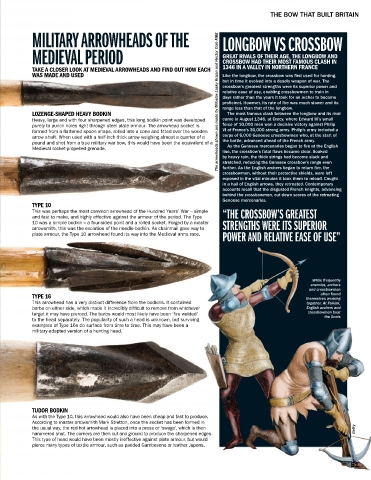
            LOZENGE-SHAPED HEAVY BODKIN                                          Themostfamousclashbetweenthelongbowanditsrival
            Heavy, large and with four sharpened edges, this long bodkin point was developed   cameinAugust1346,atCrecy,whereEdwardIII’ssmall
            purely to punch holes right through steel plate armour. The arrowhead socket is   force of 10,000 men won a decisive victory against Philip
            formed from a fl attened spoon shape, rolled into a cone and fi tted over the wooden   VI of France’s 30,000-strong army. Philip’s army included a
            arrow shaft. When used with a half-inch-thick arrow weighing almost a quarter of a   corpsof6,000Genoesecrossbowmenwho,atthestartof
            pound and shot from a true military war bow, this would have been the equivalent of a   the battle, advanced ahead of the French army.
            Medieval rocket-propelled grenade.                                   AstheGenoesemercenariesbegantofireattheEnglish
                                                                               line, the crossbow’s fatal flaws became clear. Soaked
                                                                               by heavy rain, the thick strings had become slack and
                                                                               stretched,reducingtheGenoesecrossbow’srangeeven
                                                                               further.AstheEnglisharchersbegantoreturnfire,the
                                                                               crossbowmen, without their protective shields, were left
                                                                               exposed in the vital minutes it took them to reload. Caught
                                                                               in a hail of English arrows, they retreated. Contemporary
                                                                               accounts recall that the disgusted French knights, advancing
                                                                               behind the crossbowmen, cut down scores of the retreating
                                                                               Genoese mercenaries.
            TYPE 10
            This was perhaps the most common arrowhead of the Hundred Years’ War – simple  “THE CROSSBOW’S GREATEST
            and fast to make, and highly effective against the armour of the period. The Type
            10 was a simple bodkin – a four-sided point and a rolled socket. Forged by a master  STRENGTHS WERE ITS SUPERIOR
            arrowsmith, this was the evolution of the needle-bodkin. As chainmail gave way to
                                                                               POWER AND RELATIVE EASE OF USE”
            plate armour, the Type 10 arrowhead found its way into the Medieval arms race.


                                                                                                               While frequently
                                                                                                              enemies, archers
                                                                                                              and crossbowmen
                                                                                                                  often found
            TYPE 16
                                                                                                             themselves working
            This arrowhead has a very distinct difference from the bodkins. It contained                     together. At Falkirk,
            barbs on either side, which made it incredibly diffi cult to remove from whichever               English archers and
            target it may have pierced. The barbs would most likely have been ‘fire welded’                  crossbowmen beat
                                                                                                                   the Scots
            to the head separately. The popularity of such a head is unknown, but surviving
            examples of Type 16s do surface from time to time. This may have been a
            military-adapted version of a hunting head.


            TUDOR BODKIN
            As with the Type 10, this arrowhead would also have been cheap and fast to produce.
            According to master arrowsmith Mark Stretton, once the socket has been formed in
            the usual way, the red-hot arrowhead is placed into a press or ‘swage’, which is then                             Getty
            hammered shut. The corners are then cut and ground to produce the sharpened edges.
            This type of head would have been mostly ineffective against plate armour, but would
            pierce many types of textile armour, such as padded Gambesons or leather Jupons.


                                                                                                                            51

