


Page 54 - History of War - Issue 18-15
P. 54
THE FORGOTTEN SIKH REGIMENTS OF THE BRITISH EMPIRE


          reasonable option open to them. Seeing it as “IMPRESSEDBYTHE PERFORMANCE OF THE SIKH WARRIORS IN
          so fighting for the British Raj was the most
          Kingdom, the Sikh soldiers used the uprising THETWOWARS,THE BRITISH DECIDED TO TAKE ON THE LOCAL
          anattempttoregainlandforarenewedMughal
          asanopportunitytostrikebackatthepeople  SOLDIERSANDUSETHEIR FIGHTING SKILLS WITHIN THEIR OWN
          who had fought against them in the past.
          targetaftertheyhadsupportedtheBritishin RANKS;THESIKHPIONEERS WERE BORN”
           TheHindustaniPoorbiaswerethemain
          theAnglo-SikhWarsandwelcomedthedemise
          oftheSikhEmpire.Thisillfeelingwasexploited  their combined military forces were behind the
          bytheBritish,andmanySikhswereluredby  empire. These communities had historically
          theideaofacareerinthearmy.Previously,the  been opposed to Maharaja Ranjit Singh in the
          armyhadsufferedrevolts,sofreshrecruits  days of the Sikh Empire, so had always sought
          tobolstertherankscouldn’thavecomeata  an alliance with the British.
          better time.                           The suppressing of the rebellion on 20 June
           For the newcomers, the British Army  1858 was of great benefit to the vast majority
          offered generous opportunities and respect  of Sikhs, who now reaped the economic and
          forreligiouspracticeswithinitsranks.After  military benefits that came with an alliance
          disrespecting Muslim and Hindu practices in  to the British, and had no fear of a Mughal
          the past, the British generals had learned that  Persianate society returning anytime soon.
          embracing and appreciating local culture was
          the best way to get potential Sikh soldiers on  Wars in the north
          their side and utilise them in their forces.  With the rebellion over, the British regained
           Despite the antagonism towards the  control over the country under the new
          rebellion, there were actually some who  British Raj, which tightened its grip over the
          remained against the British. On one occasion,  subcontinent. With the Sikh lands in the north
          manySikhsgatheredinthecityofRoparin  west now secure, the empire was close to
          support of the uprising. This was a short-lived  clashing with the aspirations of one of its
          movement,however,astheleaderswere    most formidable rivals, the Russians. The
          promptlyputtodeathiftheydecidedtoside  British once again employed many Sikhs to
          with the rebellion. The most prominent leaders  aid their forces, and they marched into the
          whosupportedtheBritishcausewerethe   Afghan capital, Kabul, as part of several class
          Cis-Satluj chiefs of Patiala, Malerkotla, Kalsia,  company regiments. The Second Anglo-Afghan  The15thSikhCompany
                                                                                      on the march in France
          Nabha, Faridkot and Jind, who ensured that  War had begun.
                                                                                      in the summer of 1915
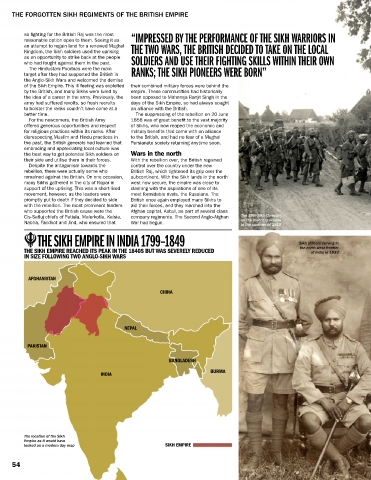
              THESIKHEMPIREININDIA1799–1849                                                               Sikh officers serving in

                                                                                                          the north-west frontier
          THESIKHEMPIREREACHEDITSPEAKINTHE1840SBUTWASSEVERELYREDUCED                                          of India in 1933
          IN SIZE FOLLOWING TWO ANGLO-SIKH WARS


           AFGHANISTAN

                                                         CHINA


                                             NEPAL

           PAKISTAN


                                                            BANGLADESH
                                                                           BURMA
                                    INDIA


          ThelocationoftheSikh
          Empire as it would have
          looked on a modern day map                       SIKH EMPIRE


     54

