


Page 18 - Mammal (DK Eyewitness)
P. 18
Mammal senses


                                             One reason for the mammals’
                                             success is their “good sense” - their
                                             generally well-developed senses of
                                             sight, hearing, smell, taste, and touch.
                                             Each sense has been molded by
                                             evolution to fit its owner’s way of life.
                                             Good vision would be of little use to an
                                             underground mammal like a mole (p. 56),
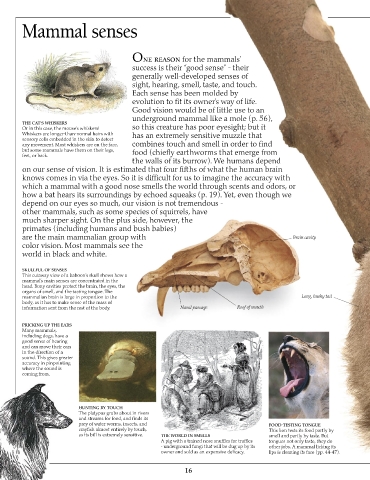
        THE CAT’S WHISKERS
        Or in this case, the mouse’s whiskers!   so this creature has poor eyesight; but it
        Whiskers are longer-than-normal hairs with   has an extremely sensitive muzzle that
        sensory cells embedded in the skin to detect
        any movement. Most whiskers are on the face,   combines touch and smell in order to find
        but some mammals have them on their legs,   food (chiefly earthworms that emerge from
        feet, or back.
                                             the walls of its burrow). We humans depend
        on our sense of vision. It is estimated that four fifths of what the human brain
        knows comes in via the eyes. So it is difficult for us to imagine the accuracy with
        which a mammal with a good nose smells the world through scents and odors, or
        how a bat hears its surroundings by echoed squeaks (p. 19). Yet, even though we
        depend on our eyes so much, our vision is not tremendous -
        other mammals, such as some species of squirrels, have
        much sharper sight. On the plus side, however, the
        primates (including humans and bush babies)
        are the main mammalian group with                                                         Brain cavity
        color vision. Most mammals see the
        world in black and white.

        SKULLFUL OF SENSES
        This cutaway view of a baboon’s skull shows how a
        mammal’s main senses are concentrated in the
        head. Bony cavities protect the brain, the eyes, the
        organs of smell, and the tasting tongue. The
        mammalian brain is large in proportion to the                                                Long, bushy tail
        body, as it has to make sense of the mass of
        information sent from the rest of the body.          Nasal passage      Roof of mouth


        PRICKING UP THE EARS
        Many mammals,
        including dogs, have a
        good sense of hearing
        and can move their ears
        in the direction of a
        sound. This gives greater
        accuracy in pinpointing
        where the sound is
        coming from.


                           HUNTING BY TOUCH
                           The platypus grubs about in rivers
                           and streams for food, and finds its
                           prey of water worms, insects, and                              FOOD-TESTING TONGUE
                           crayfish almost entirely by touch,                             This lion tests its food partly by
                           as its bill is extremely sensitive.  THE WORLD IN SMELLS       smell and partly by taste. But
                                                      A pig with a trained nose snuffles for truffles   tongues not only taste, they do
                                                      - underground fungi that will be dug up by its   other jobs. A mammal licking its
                                                      owner and sold as an expensive delicacy.  lips is cleaning its face (pp. 44-47).

                                                              1


 (c) 2011 Dorling Kindersley. All Rights Reserved.

