


Page 16 - Mammal (DK Eyewitness)
P. 16
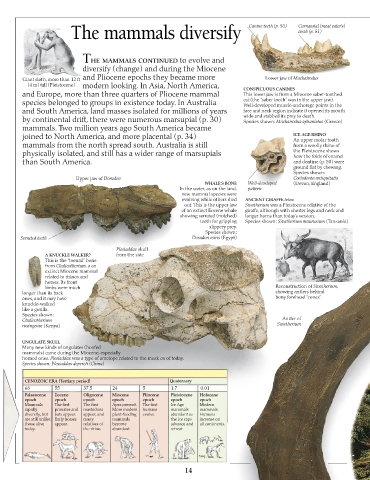
The mammals diversify Canine teeth (p. 50) Carnassial (meat eater’s)
teeth (p. 51)
The mammals continued to evolve and
diversify (change) and during the Miocene
Giant sloth, more than 12 ft and Pliocene epochs they became more Lower jaw of Machairodus
(4 m) tall (Pleistocene) modern looking. In Asia, North America, CONSPICUOUS CANINES
and Europe, more than three quarters of Pliocene mammal This lower jaw is from a Miocene saber-toothed
species belonged to groups in existence today. In Australia cat (the “saber tooth” was in the upper jaw).
Well-developed muscle-anchorage points in the
and South America, land masses isolated for millions of years face and neck region indicate it opened its mouth
by continental drift, there were numerous marsupial (p. 30) wide and stabbed its prey to death.
Species shown: Machairodus aphanistus (Greece)
mammals. Two million years ago South America became
joined to North America, and more placental (p. 34) ICE AGE RHINO
An upper molar tooth
mammals from the north spread south. Australia is still from a woolly rhino of
physically isolated, and still has a wider range of marsupials the Pleistocene shows
how the folds of enamel
than South America. and dentine (p. 50) were
ground flat by chewing.
Species shown:
Upper jaw of Dorudon Coelodonta antiquitatis
WHALE’S BONE Welldeveloped (Devon, England)
In the water, as on the land, pattern
new mammal species were
evolving while others died ANCIENT GIRAFFE below
out. This is the upper jaw Sivatherium was a Pleistocene relative of the
of an extinct Eocene whale giraffe, although with shorter legs and neck and
showing serrated (notched) longer horns than today’s version.
teeth for gripping Species shown: Sivatherium maurusium (Tanzania)
slippery prey.
Species shown:
Serrated teeth Dorudon osiris (Egypt)
Plesiaddax skull
A KNUCKLE WALKER? from the side
This is the “toenail” bone
from Chalicotherium, a an
extinct Miocene mammal
related to rhinos and
horses. Its front
limbs were much Reconstruction of Sivatherium,
longer than its back showing antlers behind
ones, and it may have bony forehead “cones”
knuckle-walked
like a gorilla.
Species shown:
Chalicotherium Antler of
rusingense (Kenya) Sivatherium
UNGULATE SKULL
Many new kinds of ungulates (hoofed
mammals) came during the Miocene, especially
horned ones. Plesiaddax was a type of antelope related to the musk ox of today.
Species shown: Plesiaddax depereti (China)
CENOZOIC ERA (Tertiary period) Quaternary
66 55 37.5 24 5 1.7 0.01
Palaeocene Eocene Oligocene Miocene Pliocene Pleistocene Holocene
epoch epoch epoch epoch epoch epoch epoch
Mammals The first The first Apes present. The first Ice Age Modern
rapidly primates and mastodons More modern humans mammals mammals.
diversify, but bats appear. appear, and plant-feeding evolve. abundant as Humans
are still unlike Early horses many mammals the ice caps increase on
those alive appear. relatives of become advance and all continents.
today. the rhino. abundant. retreat.
14
(c) 2011 Dorling Kindersley. All Rights Reserved.

