


Page 33 - Mammal (DK Eyewitness)
P. 33
KANGAROOS AND WALLABIES               An even earlier birth
       This mother red-necked (or Bennett’s) wallaby
       with her joey (baby) is a typical member of the
       kangaroo and wallaby family. There are about   Only three of the 4,000 or so mammal species lay
       50 species in the family, out of the 120 or so   eggs. These are the platypus of Australia, the
       marsupial species found in Australia. There is no   short-beaked echidna of Australia and New
       real difference between a kangaroo and a   Guinea, and the long-beaked echidna of New
       wallaby: larger species tend to be called   Guinea. They are the only members of the Order   Platypus head
       kangaroos, and smaller ones wallabies. The
       scientific name for the family is Macropodidae,   Monotremata (p. 8), the egg-laying mammals.
       which means “big feet.” This reflects the way   When the white, leathery-shelled
       they move - bounding along in great leaps on   eggs hatch, about two weeks after
       the huge feet, using the tail as a counterbalance.   laying, the young feed on mother’s
       Some large kangaroos can travel at 40 mph
       (nearly 65 km/h). When grazing on plants (all   milk. The milk oozes from enlarged
       kangaroos and wallabies are herbivorous) they   pores on to the skin, where the     Echidna head
       move slowly, resting their tails and front paws   babies drink it; monotremes have
       on the ground as they swing the back legs   no teats (p. 36).             Echidna
       forward. At rest, they sit back on their tails or lie                       egg
       lazily in the shade of a tree. The red-necked
       wallaby was one of the first marsupials seen by                                     MARSUPIAL MONKEY?
       Europeans, when the British First Fleet anchored                                    Some opossums - marsupials of the
       in Sydney Cove in 1788. Its traditional name is                                     Americas - look rather like monkeys;
       the “brusher,” since it prefers brush and wooded                                    but they are not closely related
       areas rather than more open country. The four-                                      except by both being mammals. This
       month-old joey is now beginning to leave his                                        woolly opossum lives in the tropical
       mother. But at the first sign of danger he hops                                     forests of Central America and
       back to the safety of the pouch. He leaves the                                      northern South America. Like a
       pouch at nine months, but will not be weaned                                        monkey it has large, forward-facing
       (p. 33) until about 12 months old.                                                  eyes, to judge distances accurately as
                                                                                           it moves through the branches. It
                                                                                           also has a prehensile tail, like some
                                                                                           South American monkeys. It is a fruit
                                                                                           and nectar feeder, like many
                                                                                           monkeys. Yet its breeding is typically
                                                                                           marsupial. After birth, the babies
                                                                                           hold on to the teats in the pouch
                                                                                           continually. As they grow, they are
                                                                                           able to clamber around on their
                                                                                           mother and get a ride.


               After its epic journey to the
              pouch, the developing kangaroo
               attaches itself to the teat and   LOST FOR EVER?
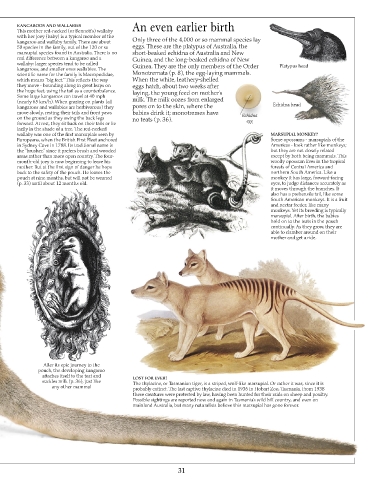
               suckles milk (p. 36), just like   The thylacine, or Tasmanian tiger, is a striped, wolf-like marsupial. Or rather it was, since it is
                  any other mammal           probably extinct. The last captive thylacine died in 1936 in Hobart Zoo, Tasmania. From 1938
                                             these creatures were protected by law, having been hunted for their raids on sheep and poultry.
                                             Possible sightings are reported now and again in Tasmania’s wild hill country, and even on
                                             mainland Australia, but many naturalists believe this marsupial has gone forever.


                                                            31


 (c) 2011 Dorling Kindersley. All Rights Reserved.

