


Page 34 - Mammal (DK Eyewitness)
P. 34
Fast breeders                                                                                 Bodies have
                                                                                                      no fur


        Mice are small, relatively defenseless
        mammals. They are easy prey for many
        other creatures. Their strategy for
        survival is to breed at an
        extraordinary rate. A female house
        mouse starts to breed when she is
        six weeks old and can have up to
        10 litters in a year, with about five
        to seven babies in a litter. If all the
        young survive and breed in turn, one pair
        of mice may become half a million mice!


               Developing tail                              Nest made of                                      Tiny limbs
                                                            straw and grass

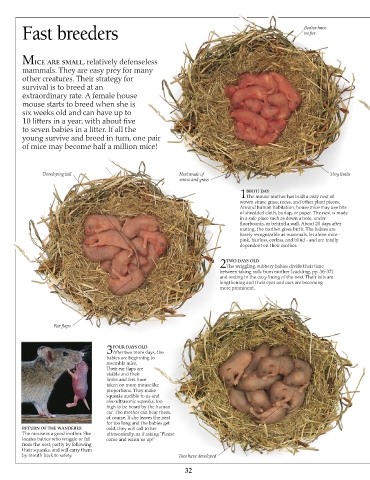
                                                                                   BIRTH DAY
                                                                                   T
                                                                                1 he mouse mother has built a cozy nest of
                                                                                woven straw, grass, moss, and other plant pieces.
                                                                                Around human habitation, house mice may use bits
                                                                                of shredded cloth, burlap, or paper. The nest is made
                                                                                in a safe place such as down a hole, under
                                                                                floorboards, or behind a wall. About 20 days after
                                                                                mating, the mother gives birth. The babies are
                                                                                barely recognizable as mammals, let alone mice -
                                                                                pink, hairless, earless, and blind - and are totally
                                                                                dependent on their mother.

                                                                            TWO DAYS OLD
                                                                            T
                                                                          2 he wriggling, rubbery babies divide their time
                                                                          between taking milk from mother (suckling, pp. 36-37)
                                                                          and resting in the cozy lining of the nest. Their tails are
                                                                          lengthening and their eyes and ears are becoming
                                                                          more prominent.


                   Ear flaps


                                      FOUR DAYS OLD
                                    3After two more days, the
                                    babies are beginning to
                                    resemble mice.
                                    Their ear flaps are
                                    visible and their
                                    limbs and feet have
                                    taken on more mouselike
                                    proportions. They make
                                    squeaks audible to us and
                                    also ultrasonic squeaks, too
                                    high to be heard by the human
                                    ear. The mother can hear them,
                                    of course. If she leaves the nest
                                    for too long and the babies get
        RETURN OF THE WANDERER      cold, they will call to her
        The mouse is a good mother. She   ultrasonically, as if asking “Please
        locates babies who wriggle or fall   come and warm us up!”
        from the nest, partly by following
        their squeaks, and will carry them
        by mouth back to safety.                            Toes have developed
                                                              32


 (c) 2011 Dorling Kindersley. All Rights Reserved.

