Page 36 - Mammal (DK Eyewitness)
P. 36

Nine lives


        A mammal whose babies develop inside the mother’s womb is known as a placental
        mammal. The womb protects the babies until they are fairly well developed. A special organ
        called the placenta supplies the baby with food and oxygen. Cats are placental mammals and the
        babies are born with all their fur. Compare the kittens with the baby mice on page 32 (also
        placental) and the baby wallaby on page 30 (a marsupial). In many species, the gestation period
        (the length of time it takes for the baby to develop in the womb) is linked to body size. In shrews
        it is about two weeks; in rhinos, 16 months. The birth itself is a dangerous time for mother and
                                                                        babies, since they are unable to flee and
                                                                         the smell of the birth fluids may give
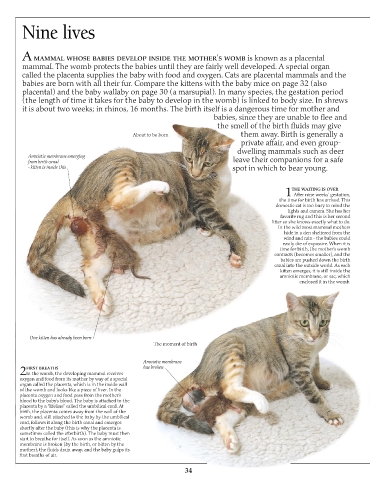
                                             About to be born                    them away. Birth is generally a
                                                                                 private affair, and even group-
                                                                                dwelling mammals such as deer
          Amniotic membrane emerging
          from birth canal                                                    leave their companions for a safe
          ­ kitten is inside this                                             spot in which to bear young.


                                                                                                  THE WAITING IS OVER
                                                                                               1 After nine weeks’ gestation,
                                                                                             the time for birth has arrived. This
                                                                                            domestic cat is too busy to mind the
                                                                                                lights and camera. She has her
                                                                                              favorite rug and this is her second
                                                                                           litter so she knows exactly what to do.
                                                                                             In the wild most mammal mothers
                                                                                               hide in a den sheltered from the
                                                                                               wind and rain - the babies could
                                                                                               easily die of exposure. When it is
                                                                                              time for birth, the mother’s womb
                                                                                            contracts (becomes smaller), and the
                                                                                              babies are pushed down the birth
                                                                                            canal into the outside world. As each
                                                                                              kitten emerges, it is still inside the
                                                                                              amniotic membrane, or sac, which
                                                                                                    enclosed it in the womb.


           One kitten has already been born
                                                    The moment of birth


                                                Amniotic membrane
          FIRST BREATHS                         has broken
        2In the womb, the developing mammal receives
        oxygen and food from its mother by way of a special
        organ called the placenta, which is in the inside wall
        of the womb and looks like a piece of liver. In the
        placenta oxygen and food pass from the mother’s
        blood to the baby’s blood. The baby is attached to the
        placenta by a “lifeline” called the umbilical cord. At
        birth, the placenta comes away from the wall of the
        womb and, still attached to the baby by the umbilical
        cord, follows it along the birth canal and emerges
        shortly after the baby (this is why the placenta is
        sometimes called the afterbirth). The baby must then
        start to breathe for itself. As soon as the amniotic
        membrane is broken (by the birth, or bitten by the
        mother), the fluids drain away, and the baby gulps its
        first breaths of air.
                                                              34


 (c) 2011 Dorling Kindersley. All Rights Reserved.
   31   32   33   34   35   36   37   38   39   40   41