


Page 62 - Mammal (DK Eyewitness)
P. 62
Badger footprints
Tracks and trails
Domestic cat
Walking through any wild place, we
are aware of many animals. Birds fly above,
insects buzz from one flower to another, and
fish rise to snatch food from the water’s surface.
But where are all the mammals? With their swift and active
habits and their keen senses (p. 16) they make themselves scarce,
fearing the large creature blundering past. Others, being nocturnal, are
well hidden and asleep. Although we are mammals ourselves, we seldom
have the time and patience to glimpse our wild relatives. Often, we only
know of their presence from the tracks and signs they leave behind;
footprints and belly- or tail-drags in the ground, leftover bits of food with
teeth marks, droppings, burrow entrances with dug-out soil, bits of hair
caught on twigs and snagged on thorns, and castoffs such as antlers (p. 62).
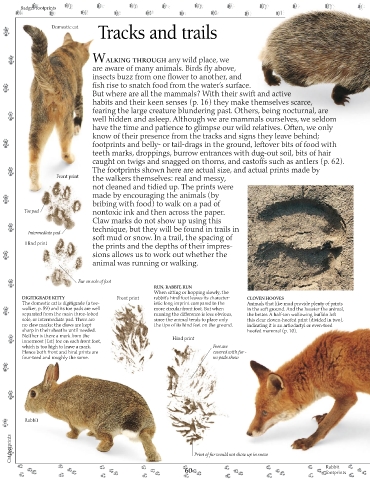
The footprints shown here are actual size, and actual prints made by
Front print the walkers themselves: real and messy,
not cleaned and tidied up. The prints were
made by encouraging the animals (by
bribing with food) to walk on a pad of
Toe pad nontoxic ink and then across the paper.
Claw marks do not show up using this
technique, but they will be found in trails in
Intermediate pad
soft mud or snow. In a trail, the spacing of
Hind print the prints and the depths of their impres-
sions allows us to work out whether the
animal was running or walking.
Fur on sole of foot
RUN, RABBIT, RUN
When sitting or hopping slowly, the
DIGITIGRADE KITTY Front print rabbit’s hind foot leaves its character- CLOVEN HOOVES
The domestic cat is digitigrade (a toe- istic long imprint compared to the Animals that like mud provide plenty of prints
walker, p. 59) and its toe pads are well more circular front foot. But when in the soft ground. And the heavier the animal,
separated from the main three-lobed running the difference is less obvious, the better. A half-ton wallowing buffalo left
sole, or intermediate pad. There are since the animal tends to place only this clear cloven-hoofed print (divided in two),
no claw marks: the claws are kept the tips of its hind feet on the ground. indicating it is an artiodactyl or even-toed
sharp in their sheaths until needed. hoofed mammal (p. 10).
Neither is there a mark from the
innermost (1st) toe on each front foot, Hind print
which is too high to leave a mark. Feet are
Hence both front and hind prints are covered with fur
four-toed and roughly the same. no pads show
Rabbit
Cat footprints Print of fur would not show up in snow
0 Rabbit
footprints
(c) 2011 Dorling Kindersley. All Rights Reserved.

