


Page 60 - Mammal (DK Eyewitness)
P. 60
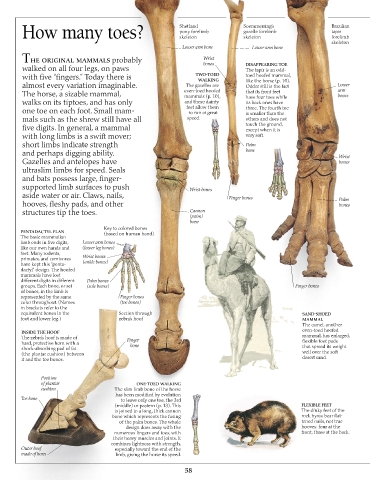
How many toes?                                      Shetland              Soemmerring’s                Brazilian
                                                                                                               tapir
                                                                                  gazelle forelimb
                                                            pony forelimb
                                                                                  skeleton
                                                            skeleton
                                                                                                               forelimb
                                                                                                               skeleton
                                                             Lower arm bone         Lower arm bone
        The original mammals probably                               Wrist
        walked on all four legs, on paws                            bones         DISAPPEARING TOE
                                                                                  The tapir is an odd-
        with five “fingers.” Today there is                       TWO-TOED        toed hoofed mammal,
                                                                   WALKING
        almost every variation imaginable.                     The gazelles are   like the horse (p. 10).        Lower
                                                                                  Odder still is the fact
        The horse, a sizable mammal,                          even-toed hoofed    that its front feet            arm
                                                                                                                 bones
                                                              mammals (p. 10),
                                                                                  have four toes while
        walks on its tiptoes, and has only                    and these dainty    its back ones have
        one toe on each foot. Small mam-                       feet allow them    three. The fourth toe
                                                               to run at great
                                                                                  is smaller than the
        mals such as the shrew still have all                  speed.             others and does not
        five digits. In general, a mammal                                         touch the ground,
                                                                                  except when it is
        with long limbs is a swift mover;                                         very soft.
        short limbs indicate strength                                             Palm
        and perhaps digging ability.                                              bone                           Wrist
        Gazelles and antelopes have                                                                              bones
        ultraslim limbs for speed. Seals
        and bats possess large, finger-
        supported limb surfaces to push                         Wrist bones
        aside water or air. Claws, nails,                                    Finger bones
        hooves, fleshy pads, and other                                                                           Palm
                                                                                                                 bones
        structures tip the toes.                                Cannon
                                                                (palm)
                                                                bone
                                   Key to colored bones
        PENTADACTYL PLAN           (based on human hand)
        The basic mammalian
        limb ends in five digits,   Lower arm bones
        like our own hands and   (lower leg bones)
        feet. Many rodents,
        primates, and carnivores   Wrist bones
        have kept this “penta-   (ankle bones)
        dactyl” design. The hoofed
        mammals have lost
        different digits in different   Palm bones
        groups. Each bone, or set   (sole bones)                                                   Finger bones
        of bones, in the limb is
        represented by the same          Finger bones
        color throughout. (Names         (toe bones)
        in brackets refer to the
        equivalent bones in the         Section through                                              SAND-SHOED
        foot and lower leg.)            zebra’s hoof                                                 MAMMAL
                                                                                                     The camel, another
                                                                                                     even-toed hoofed
        INSIDE THE HOOF
        The zebra’s hoof is made of        Finger                                                    mammal, has enlarged,
        hard, protective horn with a        bone                                                     flexible foot pads
        shock-absorbing pad of fat                                                                   that spread its weight
        (the plantar cushion) between                                                                well over the soft
        it and the toe bones.                                                                        desert sand.


               Position
               of plantar                     ONE-TOED WALKING
               cushion                 The slim limb bone of the horse
                                       has been modified by evolution
        Toe bone                         to leave only one toe, the 3rd
                                       (middle) or pastern (p. 13). This                             FLEXIBLE FEET
                                       is joined to a long, thick cannon                             The dinky feet of the
                                      bone which represents the fusing                               rock hyrax bear flat-
                                         of the palm bones. The whole                                tened nails, not true
                                           design does away with the                                 hooves: four at the
                                       numerous fingers and toes, with                               front, three at the back.
                                      their heavy muscles and joints. It
                                      combines lightness with strength,
        Outer hoof                     especially toward the end of the
        made of horn                   limb, giving the horse its speed.

                                                              5


 (c) 2011 Dorling Kindersley. All Rights Reserved.

