


Page 74 - Forbes - India (January 2020)
P. 74
ForbesLife                              food


                                                       PhotograPhs: KalPana sunder
              nside the bustling Natun Bazar neighbourhood
              of North Kolkata, we walk through narrow,
              muddy lanes, lined with small shops and
              homes, stray goats, and children playing,
         i to Makhan Lal Das & Sons. The factory-
          cum-shop has been in the business of selling
          sweetmeats since 1830, and its nondescript
          appearance is no indication of its lineage.
            Shib Nath Das is the ninth generation of a
          family that came from Debrajhat village in the
          Purba Bardhaman district of West Bengal to first
          sell sweets in the local haat, or market; he sits on
          a wooden platform, supervising the sweets that
          are being made to order. Thickened milk is made
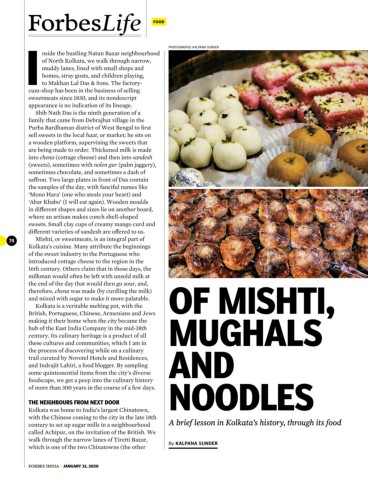
          into chena (cottage cheese) and then into sandesh
          (sweets), sometimes with nolen gur (palm jaggery),
          sometimes chocolate, and sometimes a dash of
          saffron. Two large plates in front of Das contain
          the samples of the day, with fanciful names like
          ‘Mono Hara’ (one who steals your heart) and
          ‘Abar Khabo’ (I will eat again). Wooden moulds
          in different shapes and sizes lie on another board,
          where an artisan makes conch shell-shaped
          sweets. Small clay cups of creamy mango curd and
          different varieties of sandesh are offered to us.
    74      Mishti, or sweetmeats, is an integral part of
          Kolkata’s cuisine. Many attribute the beginnings
          of the sweet industry to the Portuguese who
          introduced cottage cheese to the region in the
          16th century. Others claim that in those days, the
          milkman would often be left with unsold milk at
          the end of the day that would then go sour, and,
          therefore, chena was made (by curdling the milk)
          and mixed with sugar to make it more palatable.  Of mishti,
            Kolkata is a veritable melting pot, with the
          British, Portuguese, Chinese, Armenians and Jews
          making it their home when the city became the
          hub of the East India Company in the mid-18th   mughals
          century. Its culinary heritage is a product of all
          these cultures and communities, which I am in
          the process of discovering while on a culinary
          trail curated by Novotel Hotels and Residences,
          and Indrajit Lahiri, a food blogger. By sampling   and
          some quintessential items from the city’s diverse
          foodscape, we get a peep into the culinary history
          of more than 300 years in the course of a few days.  nOOdles

          the neighbOurs frOm next dOOr
          Kolkata was home to India’s largest Chinatown,
          with the Chinese coming to the city in the late 18th
          century to set up sugar mills in a neighbourhood   A brief lesson in Kolkata’s history, through its food
          called Achipur, on the invitation of the British. We
          walk through the narrow lanes of Tiretti Bazar,
          which is one of the two Chinatowns (the other   By Kalpana Sunder


          forbes india • January 31, 2020

