


Page 75 - Forbes - India (January 2020)
P. 75
being in Tangra) where every morning prawn baos
                                                                    and dumplings are served for breakfast from the
                                                                    sidewalks. Large stacks of aluminum steamers
                                                                    are set up on makeshift tables: There’s siumai—
                                                                    Cantonese pork and shrimp dumplings—fish
                                                                    ball soup, and even Chinese bread shaped like
                                                                    churros. One vendor sells Chinese sauces, spices
                                                                    and noodles. It’s a communal atmosphere, with
                                                                    people sitting on plastic stools and reading Chinese
                                                                    newspapers, while others chat with friends.
                                                                       We continue on our Chinese food trail with a
                                                                    visit to Eau Chew, one of the oldest family-run
                                                                    Chinese restaurants in Kolkata, which dates back
                                                                    to the 1920s. It is located on the first floor of a
                                                                    building in the rundown compound of a garage,
                                                                    above a closed petrol pump, and is open for only
                                                                    7 hours a day. Red Formica-covered tables and a
                                                                    no- frills ambience, with only a fish tank and framed
                                                                    photographs of the first owners for decoration,
                                                                    indicate that this experience is all about the
                                                                      food. Joel Huang, who runs the restaurant today
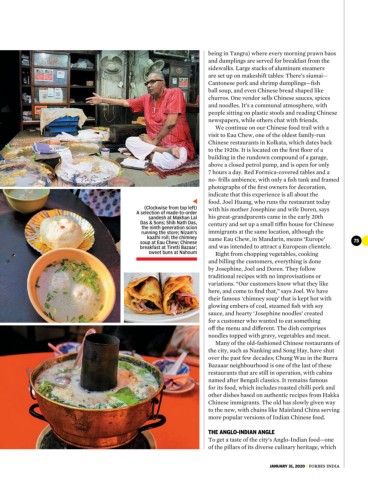
                                                (Clockwise from top left)   with his mother Josephine and wife Doren, says
                                             A selection of made-to-order
                                                 sandesh at Makhan Lal   his great-grandparents came in the early 20th
                                              Das & Sons; Shib Nath Das,   century and set up a small tiffin house for Chinese
                                               the ninth generation scion
                                               running the store; Nizam’s   immigrants at the same location, although the
                                                kaathi roll; the chimney   name Eau Chew, in Mandarin, means ‘Europe’
                                              soup at Eau Chew; Chinese                                            75
                                              breakfast at Tiretti Bazaar;   and was intended to attract a European clientele.
                                                 sweet buns at Nahoum  Right from chopping vegetables, cooking
                                                                    and billing the customers, everything is done
                                                                    by Josephine, Joel and Doren. They follow
                                                                    traditional recipes with no improvisations or
                                                                    variations. “Our customers know what they like
                                                                    here, and come to find that,” says Joel. We have
                                                                    their famous ‘chimney soup’ that is kept hot with
                                                                    glowing embers of coal, steamed fish with soy
                                                                    sauce, and hearty ‘Josephine noodles’ created
                                                                    for a customer who wanted to eat something
                                                                    off the menu and different. The dish comprises
                                                                    noodles topped with gravy, vegetables and meat.
                                                                       Many of the old-fashioned Chinese restaurants of
                                                                    the city, such as Nanking and Song Hay, have shut
                                                                    over the past few decades; Chung Wau in the Burra
                                                                    Bazaaar neighbourhood is one of the last of these
                                                                    restaurants that are still in operation, with cabins
                                                                    named after Bengali classics. It remains famous
                                                                    for its food, which includes roasted chilli pork and
                                                                    other dishes based on authentic recipes from Hakka
                                                                    Chinese immigrants. The old has slowly given way
                                                                    to the new, with chains like Mainland China serving
                                                                    more popular versions of Indian Chinese food.

                                                                    the anglO-indian angle
                                                                    To get a taste of the city’s Anglo-Indian food—one
                                                                    of the pillars of its diverse culinary heritage, which


                                                                                        January 31, 2020 • forbes india

