


Page 76 - Forbes - India (January 2020)
P. 76
ForbesLife                              food


          is  an amalgam of  Portuguese, French and British
          influences—we go to Scoop, inside the New Empire
          Cinema complex, in the Dharmatala area. It is an
          ice cream parlour and multi-cuisine restaurant
          owned by Joanna Mantosh, an Anglo Indian, and
          her husband. They have cooked up a special Anglo-
          Indian meal for us: Jungli pulao with chicken
          curry, yellow rice with coconut milk and turmeric,
          pantaras (deep fried, breaded meat-stuffed
          pancakes), and chicken vindaloo. Anglo Indian food
          was not an integral part of the restaurant scene in
          Kolkata in the past; it was cooked more at home
          by families, and shared within the community and
          served in a mess or canteen run by the community.
            In the early 19th century, Kolkata was home
          to a vibrant Jewish community of almost 20,000
          people. Today, even though the community has
          dwindled, their beautiful synagogues, such as            originates, was introduced in Bengal under
          the Magen David and the Beth El in the Burra   Flury’s,   Mughal emperor Shah Jehan in the 17th century,
                                                       a stylish
          Bazaar area, survive and are manned by Muslim   tea room   when Burdwan became a revenue collection
          caretakers. Inside the labyrinthine alleys of New   started in   centre for Bengal. Mughlai parathas stuffed
                                                       1927 by a
          Market in Dharmatala, lined with shops selling   Swiss couple  with kheema, and biryani were some of the
          everything from Portuguese ‘Bandel cheese’               most popular dishes at that time, and continue
          to garments, furnishings and crockery, stands            to remain so. Mughlai cuisine was also brought
          Nahoum, the oldest Jewish bakery in town.                in from Awadh by its 10th and last nawab,
    76      Founded by Nahoum Israel, a Baghdadi Jew, in           Wajid Ali Shah in the 19th century. Many of
          1902, the shop houses vintage teak wood furniture,       these dishes also had Turkish and Afghan
          and glass shelves heaving with fruit and plum cakes,     influences, from the spices to cooking methods.
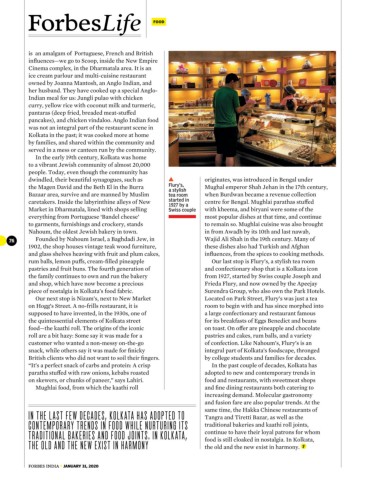
          rum balls, lemon puffs, cream-filled pineapple             Our last stop is Flury’s, a stylish tea room
          pastries and fruit buns. The fourth generation of        and confectionary shop that is a Kolkata icon
          the family continues to own and run the bakery           from 1927, started by Swiss couple Joseph and
          and shop, which have now become a precious               Frieda Flury, and now owned by the Apeejay
          piece of nostalgia in Kolkata’s food fabric.             Surendra Group, who also own the Park Hotels.
            Our next stop is Nizam’s, next to New Market           Located on Park Street, Flury’s was just a tea
          on Hogg’s Street. A no-frills restaurant, it is          room to begin with and has since morphed into
          supposed to have invented, in the 1930s, one of          a large confectionary and restaurant famous
          the quintessential elements of Kolkata street            for its breakfasts of Eggs Benedict and beans
          food—the kaathi roll. The origins of the iconic          on toast. On offer are pineapple and chocolate
          roll are a bit hazy: Some say it was made for a          pastries and cakes, rum balls, and a variety
          customer who wanted a non-messy on-the-go                of confection. Like Nahoum’s, Flury’s is an
          snack, while others say it was made for finicky          integral part of Kolkata’s foodscape, thronged
          British clients who did not want to soil their fingers.   by college students and families for decades.
          “It’s a perfect snack of carbs and protein: A crisp        In the past couple of decades, Kolkata has
          paratha stuffed with raw onions, kebabs roasted          adopted to new and contemporary trends in
          on skewers, or chunks of paneer,” says Lahiri.           food and restaurants, with sweetmeat shops
            Mughlai food, from which the kaathi roll               and fine dining restaurants both catering to
                                                                   increasing demand. Molecular gastronomy
                                                                   and fusion fare are also popular trends. At the
                                                                   same time, the Hakka Chinese restaurants of
          in the last few decades, kolkata has adopted to          Tangra and Tiretti Bazar, as well as the
          contemporary trends in food while nurturing its          traditional bakeries and kaathi roll joints,
          traditional bakeries and food joints. in kolkata,        continue to have their loyal patrons for whom
                                                                   food is still cloaked in nostalgia. In Kolkata,
          the old and the new exist in harmony                     the old and the new exist in harmony.


          forbes india • January 31, 2020

