


Page 82 - Forbes - India (January 2020)
P. 82
ForbesLife                              F&B


          Distinct from its
          Indian counterparts,
          tea from the country
          has its own story and
          flavours to boast
                                                                  SipS
          By Khursheed dinshaw


                   he journey
                   of Ceylon                                         from
                   tea began
                   in 1867,                              Sri Lanka
          T when James
          Taylor, an enterprising
          17-year-old from Scotland,
          planted the first tea bushes
          (which he had brought
          from Assam) over 19 acres
          of the Loolecondera Estate in
          Hewahata, located close to Kandy
          in Sri Lanka. But although the
          climate was nippy, and the soil rich
          enough to grow tea, Taylor was an
    82    inexperienced teenager. He then brought
          in three veterans of the industry from India,
          who trained him in the process of plucking,
          withering and rolling tea leaves, in the manufacture
          of samples, and the pruning of tea bushes.
            Fortune further favoured Taylor when, in 1869,
          an outbreak of fungus destroyed many coffee trees,
          and tea became its substitute on many estates.                 eylon tea is different from the varieties grown
            By the 1880s, there was a steady increase in                 in India as close to 95 percent of Ceylon
          tea production, and, by 1888, it had exceeded            C tea is produced through the specialised
          the production of coffee. After a central tea            orthodox manufacturing system. Almost 90 percent
          factory was set up in 1884 on Fairyland Estate           of Indian tea is produced through the mass-scale
          in Nuwara Eliya, more factories began to sprout          CTC manufacturing system. The soil, topography,
          in surrounding regions, with machinery being             elevations and rainfall that contribute to the flavour,
          imported from companies like Marshals of                 character, quality, strength and aroma of tea is
          Gainsborough and Davidson of Belfast. The                different in Sri Lanka and India,” explains Pavithri
          growth of plantations led to the development of          Peiris, director, promotion, Sri Lanka Tea Board.
          infrastructure, with road and rail networks being        In Sri Lanka, 95 percent of tea leaves are hand-
          set up to transport the tea from different plantations   plucked while in India, a significant amount of
          to Colombo, from where it was exported.                  mechanisation is also used. As an island, Sri Lanka
            What began as Sri Lanka’s first consignment            enjoys two monsoon seasons—the North-East and
        photo courtesy: Khursheed dinshaw  at `58—today contributes 5 percent of global   Different   because of more chlorophyll, while the Assamica tea
          of tea to the London auctions in 1872—consisting
                                                                   South-West—which makes its tea more diverse.
          of two packs totalling 23 pounds, and valued
                                                                     The Chinese variety of tea plant is dark green,
                                                                   plant from Assam is a lighter shade. A few decades
          manufacture and 15 percent of world exports. In
          2018, Sri Lanka produced 303,843 tonnes of tea,
                                                                   ago, hybrid bud grafted clonal plants—which

          of which 282,363 tonnes were exported, mainly
                                                                   embody the best of both the Chinese and Assam
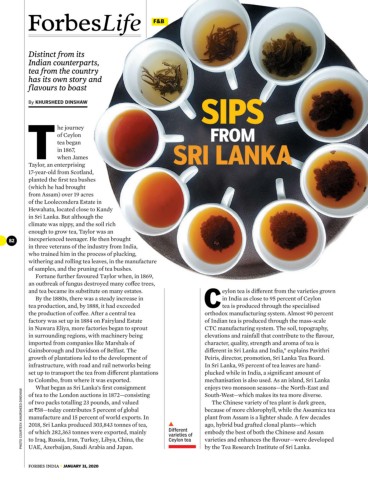
                                                       varieties of
                                                                   varieties and enhances the flavour—were developed
          to Iraq, Russia, Iran, Turkey, Libya, China, the
                                                       Ceylon tea
          UAE, Azerbaijan, Saudi Arabia and Japan.
          forbes india • january 31, 2020                          by the Tea Research Institute of Sri Lanka.

