


Page 81 - Forbes - India (January 2020)
P. 81
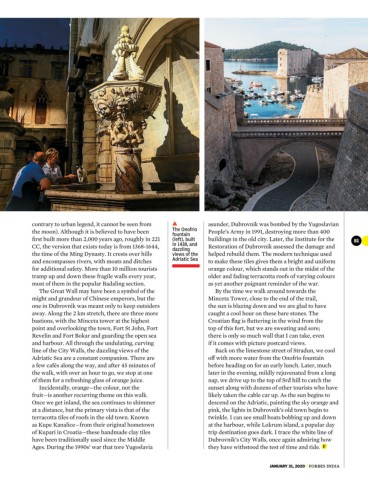
contrary to urban legend, it cannot be seen from         asunder, Dubrovnik was bombed by the Yugoslavian
           the moon). Although it is believed to have been   The Onofrio   People’s Army in 1991, destroying more than 400
                                                         fountain
           first built more than 2,000 years ago, roughly in 221   (left), built   buildings in the old city. Later, the Institute for the   81
           CC, the version that exists today is from 1368-1644,   in 1438, and   Restoration of Dubrovnik assessed the damage and
                                                         dazzling
           the time of the Ming Dynasty. It crests over hills   views of the   helped rebuild them. The modern technique used
           and encompasses rivers, with moats and ditches   Adriatic Sea   to make these tiles gives them a bright and uniform
           for additional safety. More than 10 million tourists     orange colour, which stands out in the midst of the
           tramp up and down these fragile walls every year,        older and fading terracotta roofs of varying colours
           most of them in the popular Badaling section.            as yet another poignant reminder of the war.
             The Great Wall may have been a symbol of the             By the time we walk around towards the
           might and grandeur of Chinese emperors, but the          Minceta Tower, close to the end of the trail,
           one in Dubrovnik was meant only to keep outsiders        the sun is blazing down and we are glad to have
           away. Along the 2 km stretch, there are three more       caught a cool hour on these bare stones. The
           bastions, with the Minceta tower at the highest          Croatian flag is fluttering in the wind from the
           point and overlooking the town, Fort St John, Fort       top of this fort, but we are sweating and sore;
           Revelin and Fort Bokar and guarding the open sea         there is only so much wall that I can take, even
           and harbour. All through the undulating, curving         if it comes with picture postcard views.
           line of the City Walls, the dazzling views of the          Back on the limestone street of Stradun, we cool
           Adriatic Sea are a constant companion. There are         off with more water from the Onofrio fountain
           a few cafés along the way, and after 45 minutes of       before heading on for an early lunch. Later, much
           the walk, with over an hour to go, we stop at one        later in the evening, mildly rejuvenated from a long
           of them for a refreshing glass of orange juice.          nap, we drive up to the top of Srđ hill to catch the
             Incidentally, orange—the colour, not the               sunset along with dozens of other tourists who have
           fruit—is another recurring theme on this walk.           likely taken the cable car up. As the sun begins to
           Once we get inland, the sea continues to shimmer         descend on the Adriatic, painting the sky orange and
           at a distance, but the primary vista is that of the      pink, the lights in Dubrovnik’s old town begin to
           terracotta tiles of roofs in the old town. Known         twinkle. I can see small boats bobbing up and down
           as Kupe Kanalice—from their original hometown            at the harbour, while Lokrum island, a popular day
           of Kupari in Croatia—these handmade clay tiles           trip destination goes dark. I trace the white line of
           have been traditionally used since the Middle            Dubrovnik’s City Walls, once again admiring how
           Ages. During the 1990s’ war that tore Yugoslavia         they have withstood the test of time and tide.


                                                                                        january 31, 2020 • forbes india

