


Page 80 - Forbes - India (January 2020)
P. 80
ForbesLife                              travel  photographS: ShutterStocK


          cats that strut around like they own the city.
            Despite the rich history of the region,
          Dubrovnik’s museums are fairly uninspiring.
          However, the War Photo Limited gallery—a
          permanent space showcasing the devastating
          1990s war in Yugoslavia—is a sucker punch to
          the soul, with compelling images of the horror
          and futility of war. We stroll along the Stradun,
          the pedestrianised promenade (officially called
          Placa)—it is lined with lively cafés and pubs,
          new souvenir shops and old churches—that
          cuts through the heart of the old town.
            But what I have looked forward to the most are
          the walks along the city walls. And so early one
          morning, we line up for tickets to the Dubrovnik
          City Walls—locally called ‘Dubrovački miri’—and
          find ourselves at the lower Pile Gate (pronounced
          Pile-uh), one of the main entrances to the walled
          city, complete with drawbridge and padlocks.
          It is one of the three spots from which to begin
          the walk, and after taking some local advice,
          we get there when it just opens for the day.
            Dubrovnik’s protective ramparts have been
          destroyed and repaired many times since they             right below. Before the walk, we had filled our
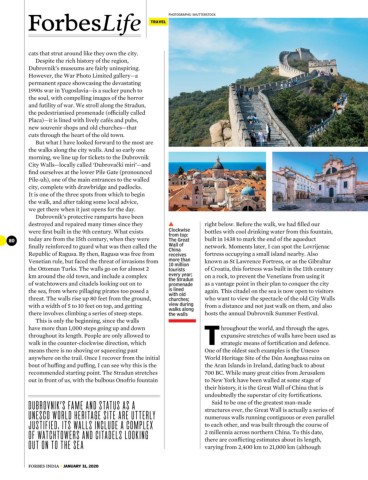
          were first built in the 9th century. What exists   Clockwise   bottles with cool drinking water from this fountain,
                                                       from top:
    80    today are from the 15th century, when they were   The Great   built in 1438 to mark the end of the aqueduct
          finally reinforced to guard what was then called the   Wall of   network. Moments later, I can spot the Lovrijenac
          Republic of Ragusa. By then, Ragusa was free from   China   fortress occupying a small island nearby. Also
                                                       receives
          Venetian rule, but faced the threat of invasions from   more than   known as St Lawrence Fortress, or as the Gibraltar
          the Ottoman Turks. The walls go on for almost 2   10 million   of Croatia, this fortress was built in the 11th century
                                                       tourists
          km around the old town, and include a complex   every year;   on a rock, to prevent the Venetians from using it
          of watchtowers and citadels looking out on to   the Stradun   as a vantage point in their plan to conquer the city
                                                       promenade
          the sea, from where pillaging pirates too posed a   is lined   again. This citadel on the sea is now open to visitors
          threat. The walls rise up 80 feet from the ground,   with old   who want to view the spectacle of the old City Walls
                                                       churches;
          with a width of 5 to 10 feet on top, and getting   view during   from a distance and not just walk on them, and also
          there involves climbing a series of steep steps.  walks along   hosts the annual Dubrovnik Summer Festival.
                                                       the walls
            This is only the beginning, since the walls
          have more than 1,000 steps going up and down                  hroughout the world, and through the ages,
          throughout its length. People are only allowed to             expansive stretches of walls have been used as
          walk in the counter-clockwise direction, which           t strategic means of fortification and defence.
          means there is no shoving or squeezing past              One of the oldest such examples is the Unesco
          anywhere on the trail. Once I recover from the initial   World Heritage Site of the Dún Aonghasa ruins on
          bout of huffing and puffing, I can see why this is the   the Aran Islands in Ireland, dating back to about
          recommended starting point. The Stradun stretches        700 BC. While many great cities from Jerusalem
          out in front of us, with the bulbous Onofrio fountain    to New York have been walled at some stage of
                                                                   their history, it is the Great Wall of China that is
                                                                   undoubtedly the superstar of city fortifications.
                                                                     Said to be one of the greatest man-made
          Dubrovnik’s fame anD status as a                         structures ever, the Great Wall is actually a series of
          unesco WorlD Heritage site are utterly                   numerous walls running contiguous or even parallel
          justifieD. its Walls incluDe a complex                   to each other, and was built through the course of
          of WatcHtoWers anD citaDels looking                      2 millennia across northern China. To this date,
                                                                   there are conflicting estimates about its length,
          out on to tHe sea                                        varying from 2,400 km to 21,000 km (although


          forbes india • january 31, 2020

