


Page 83 - Forbes - India (January 2020)
P. 83
It takes about two to three years for the                      East. “Ceylon white tea is known as Silver
           tea plant to be ready for plucking, which                        Tips and is the country’s most expensive
           continue for four to seven days. If the shoot                    tea. It is manually harvested and rolled,
           is left unplucked for more than a week, its                      and dried in the sun,” adds Gamini.
           healthy chemical components are reduced.                           Although climate, soil and elevation
           Almost all the tea—two leaves and a bud—is                       are crucial to the flavour of tea and
           plucked by hand, by women, while summer                          decide its variations, the leaves are
           remains the preferred season for plucking.                       graded on the basis of their size. For
             The plucked leaves are first withered                          instance, Orange Pekoe, which is the
           by spreading them on troughs fitted with                         highest grade of tea, has large leaves.
           fans that blow air over them. They are                           “When the leaves are bigger, the tea is
           then passed through rolling machines                             light. It also has low caffeine content and
           that squeeze the juice out of the leaves,                        is exported to countries with a warm
           giving the tea its flavour. “The leaves                          climate, like in the Middle East,” says
           are then fermented—for between half                              Gamini Weerasooriya, general manager   83
           an hour to three hours—in a cool and                             of the Halpewatte Tea Factory, in Ella.
           humid area to enable oxidation, which                            Other grades of tea include Broken
           changes their colour from green to                               Orange Pekoe, Pekoe, Orange Pekoe A,
           copper. They are then dried by passing hot air over      Orange Pekoe 1, Broken Orange Pekoe Fanning
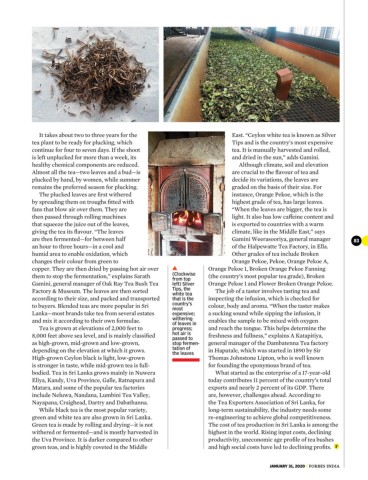
           them to stop the fermentation,” explains Sarath   (Clockwise   (the country’s most popular tea grade), Broken
                                                         from top
           Gamini, general manager of Oak Ray Tea Bush Tea   left) Silver   Orange Pekoe 1 and Flower Broken Orange Pekoe.
           Factory & Museum. The leaves are then sorted   Tips, the    The job of a taster involves tasting tea and
                                                         white tea
           according to their size, and packed and transported   that is the   inspecting the infusion, which is checked for
           to buyers. Blended teas are more popular in Sri   country’s   colour, body and aroma. “When the taster makes
                                                         most
           Lanka—most brands take tea from several estates   expensive;   a sucking sound while sipping the infusion, it
           and mix it according to their own formulae.   withering   enables the sample to be mixed with oxygen
                                                         of leaves in
             Tea is grown at elevations of 2,000 feet to   progress;   and reach the tongue. This helps determine the
           8,000 feet above sea level, and is mainly classified   hot air is   freshness and fullness,” explains A Katapitiya,
                                                         passed to
           as high-grown, mid-grown and low-grown,       stop fermen-  general manager of the Dambatenna Tea factory
           depending on the elevation at which it grows.   tation of    in Haputale, which was started in 1890 by Sir
                                                         the leaves
           High-grown Ceylon black is light, low-grown              Thomas Johnstone Lipton, who is well known
           is stronger in taste, while mid-grown tea is full-       for founding the eponymous brand of tea.
           bodied. Tea in Sri Lanka grows mainly in Nuwera             What started as the enterprise of a 17-year-old
           Eliya, Kandy, Uva Province, Galle, Ratnapura and         today contributes 11 percent of the country’s total
           Matara, and some of the popular tea factories            exports and nearly 2 percent of its GDP. There
           include Neluwa, Nandana, Lumbini Tea Valley,             are, however, challenges ahead. According to
           Nayapana, Craighead, Dartry and Dabathanna.              the Tea Exporters Association of Sri Lanka, for
             While black tea is the most popular variety,           long-term sustainability, the industry needs some
           green and white tea are also grown in Sri Lanka.         re-engineering to achieve global competitiveness.
           Green tea is made by rolling and drying—it is not        The cost of tea production in Sri Lanka is among the
           withered or fermented—and is mostly harvested in         highest in the world. Rising input costs, declining
           the Uva Province. It is darker compared to other         productivity, uneconomic age profile of tea bushes
           green teas, and is highly coveted in the Middle          and high social costs have led to declining profits.


                                                                                        january 31, 2020 • forbes india

