


Page 85 - Forbes - India (January 2020)
P. 85
about Miss Marple being injured and no one’s             same time wants to embrace it. We talked about
           coming to see her and she’s feeling a bit lost           how to re-contextualise that here. So, Ayeesha,
           and lonely. This is about ageing and forgetting          who’s Goan, has set it in Goa in the mid-1970s. The
           and what we remember. We play on the idea                encroachment is the hippies on the beach and the
           of memory being malleable and fluid.                     drugs and the instability that they generate, and
                                                                    Miss Mistry is trying to cope with the change.
           Q What was the need to reimagine
           this for an Indian audience?                             Q When you talk about characters with
           It seemed an anathema to me if I came to India           bigoted views, did you have the recent
           and ask Indian actors to be set in a little English      Indian political context in mind?
           village. It’s fine if an Indian director did that, but   We’re not being on the nose about it, but the same
           it just didn’t make any sense for me. I wanted to        is happening in the UK, and all over the world. You
           work with Indian actors on a story that made sense       can’t help but make those connections. Someone
           to me about who they are and what their cultural         in the play says, ‘Oh, but she’s a Muslim’. To which
           heritage is. If we didn’t reimagine the story, how       Miss Mistry says, ‘And what’s that got to do with
           would the Indian characters speak? With an English
           accent? That seems weirdly colonial and awful.

           Q you’ve directed the play before with a
           British cast. When you chose to do an Indian
           adaptation, what were you looking for?
           When I came here in May to hold auditions,
           I met a lot of actors whom I asked, ‘What
           would this character be like if they were
           Indian?’ In the end, it was more about how
           the actor portrayed the character.                                                                      85
             Once the casting emerged, Ayeesha Menon, the
           writer who re-contextualised the play for an Indian
           audience, started to shape the story around them.
           This was an unusual set of circumstances where
           the casting happened first and then the story.

           Q What sort of adaptation can the
           audience expect from this production?
           We don’t have the moralising Marple; we take             anything?’ At the same time, she’s a bigot in some
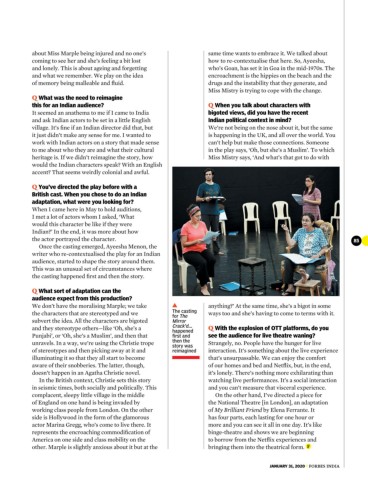
           the characters that are stereotyped and we    The casting   ways too and she’s having to come to terms with it.
                                                         for The
           subvert the idea. All the characters are bigoted   Mirror
           and they stereotype others—like ‘Oh, she’s a   Crack’d...   Q With the explosion of ott platforms, do you
                                                         happened
           Punjabi’, or ‘Oh, she’s a Muslim’, and then that   first and   see the audience for live theatre waning?
           unravels. In a way, we’re using the Christie trope   then the   Strangely, no. People have the hunger for live
                                                         story was
           of stereotypes and then picking away at it and   reimagined  interaction. It’s something about the live experience
           illuminating it so that they all start to become         that’s unsurpassable. We can enjoy the comfort
           aware of their snobberies. The latter, though,           of our homes and bed and Netflix, but, in the end,
           doesn’t happen in an Agatha Christie novel.              it’s lonely. There’s nothing more exhilarating than
             In the British context, Christie sets this story       watching live performances. It’s a social interaction
           in seismic times, both socially and politically. This    and you can’t measure that visceral experience.
           complacent, sleepy little village in the middle             On the other hand, I’ve directed a piece for
           of England on one hand is being invaded by               the National Theatre [in London], an adaptation
           working class people from London. On the other           of My Brilliant Friend by Elena Ferrante. It
           side is Hollywood in the form of the glamorous           has four parts, each lasting for one hour or
           actor Marina Gregg, who’s come to live there. It         more and you can see it all in one day. It’s like
           represents the encroaching commodification of            binge-theatre and shows we are beginning
           America on one side and class mobility on the            to borrow from the Netflix experiences and
           other. Marple is slightly anxious about it but at the    bringing them into the theatrical form.


                                                                                        january 31, 2020 • forbes india

