


Page 35 - DK Eyewitness Travel Guides - The World's Must-See Places
P. 35
CHRISTOPHER WREN GREAT BRITAIN 33
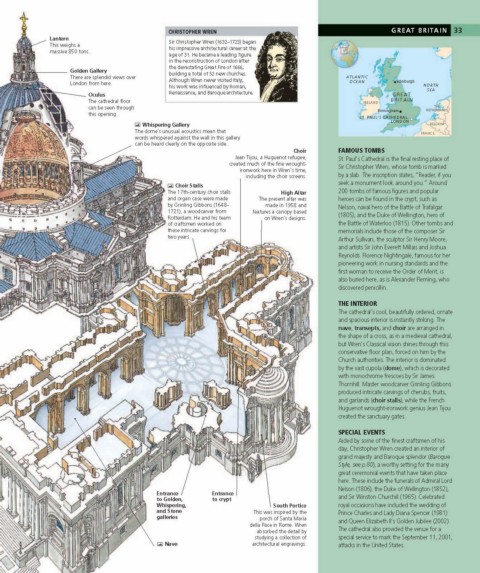
lantern sir Chris top her Wren ( 16 32-1723) began
This weighs a
massive 85 0 tons. his impressive architectural career at the
age of 31. He became a leading figure
in the reconstruction of London after
the devastating Great Fire of 1666,
::------ Golden Gallery building a total of 52 new churches.
There are splendid views over Although Wren never visited Italy, AT!Aii!T/C
London from here. OC£Aill
his work was influenced by Roman, ii!ORTH
SEA
Renaissance, and Baroque architecture.
Oculus GREAT
The cathedral floor IRElAND BRITAI N T)il J
can be seen through BirmtOg ham • NErHERr:A'NDS""'
this opening.
ST. PAUL'S C AJ~g~~~~ g
~ Whispering Gallery ~
The dome's unusual acoustics mean that FRANCE ~
words whispered against the wall in this gallery
can be heard clearly on the opposite side.
Choir FAMOUS TOMBS
Jean Tijou, a Huguenot refugee, S t Paul's Cathedral is the final resting place of
created much of the fine wrought-
ironwork here in Wren's time, Sir Christopher Wren, whose tomb is marked
including the choir screens. by a slab. The inscription states, "Reader, if you
seek a monument look around you" Around
~;ii~~~ ~ Choir S 1alls
'l The 17th-century choir stalls High Allar 2 00 tombs of famous figures and popular
and organ case were made The present altar was heroes can be found in the crypt, such as
by G rinli ng Gibbons (164 8- made in 1958 and Nelson, naval hero of the Battle of Trafalgar
1721), a woodcarver from features a canopy based
Rotterdam. He and his team on Wren's designs. (1805), and the Duke of Wellington, hero of
of craftsmen worked on the Battle of Waterloo (1815) Other tombs and
memorials include those of the composer Sir
Arthur Sullivan, the sculptor Sir Henry Moore,
and artists Sir John Everett Millais and Joshua
Reyno Ids. Florence Nightingale, famous for her
pioneering work in nursing standards and the
first woman to receive the Order of Merit, is
also buried here, as is Alexander Fleming, who
discovered penicillin.
THE INTERIOR
The cathedral's cool, beautifully ordered, ornate
and spacious interior is instantly striking. The
nave, transepts, and choir are arranged in
the shape of a cross, as in a medieval cathedral,
but Wren's Classical vision shines through this
conservative floor plan, forced on him by the
Church authorities. The interior is dominated
by the vast cupola (dome), which is decorated
with monochrome frescoes by Sir James
Thornhill. Master woodcarver Grinling Gibbons
produced intricate carvings of cherubs, fruits,
and garlands (choir stalls), while the French
Huguenot wrought-ironwork genius Jean Tijou
created the sanctuary gates.
SPECIAL EVENTS
Aided by some of the finest craftsmen of his
day, Christopher Wren created an interior of
grand majesty and Baroque splendor (Baroque
Style, see p.80), a worthy setting for the many
great ceremonial events that have taken place
here. These include the funerals of Adm ira I Lord
Nelson (1806), the Duke of Wellington (1852),
Entrance
to crypt and Sir Winston Churchill (1965). Celebrated
South Portico royal occasions have included the wedding of
This was inspired by the Prince Charles and Lady Diana Spencer ( 1981)
porch of Santa Maria
della Pace in Rome. Wren and Queen Elizabeth ll's Golden Jubilee (2002)
absorbed the detail by The cathedral also provided the venue for a
studying a collection of special service to markthe September 11, 2 001,
~ Nave architectural engravings. attacks in the United States.

