


Page 32 - DK Eyewitness Travel Guides - The World's Must-See Places
P. 32
Westminster Abbey, London
      30  EUROPE


                                                     Since  the 13th century, Westminster Abbey has been the burial
                                                     place of Britain's monarchs and the setting for many coronations
                                                     and royal weddings.  It is one of the most beautiful buildings in
            A TlArJTIC                               London, with an exceptionally diverse array of architectural
             OCEArJ       •Edinburgh
                                   rJORTH
                                    Sf A             styles,  ranging  from the austere French  Gothic of the nave to
                          GREAT
                         BRITAIN                     the astonishing complexity of the Lady Chapel.  Half national
                 IRUANO
                                                     church, half national museum, the abbey's aisles and transepts
                     Birmingham •
                ,WESTMINSTE~~~g~~ O                  are crammed with an extraordinary collection of tombs and
                                                     monuments honoring some of Britain's greatest public figures,
                                                     from politicians to poets.

         FAMOUS TOMBS AND MONUMENTS
         Many sovereigns and their consorts are buried
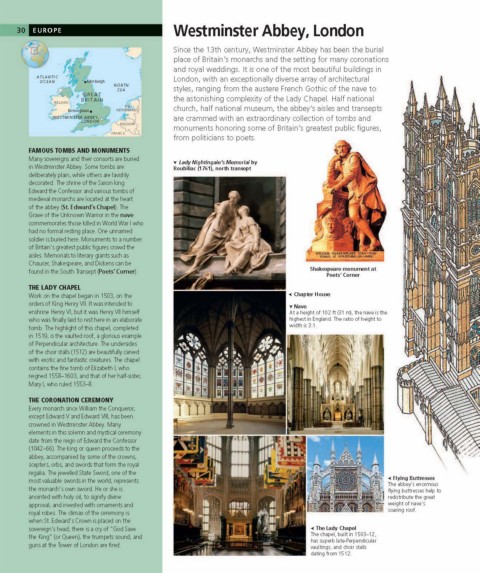
                                                     Y  Lady Nightingale's Memorial by
         in Westminster Abbey. Some tombs are        Roubiliac (1761), north transept
         deliberately pi ai n, while others are I avishly
         decorated. The shrine of the Saxon king
         Edward the Confessor and various tombs of
         medieval monarchs are located at the heart
         of the abbey (St. Edward's Chapel). The
         Grave of the Unknown Warrior in the nave
         commemorates those killed in World War I who
         had no formal resting place. One unnamed
         soldier is buried here. Monuments to a number
         of Britain's greatest publicfigures crowd the
         aisles. Memorials to literary giants such as
         Chaucer, Shakespeare, and Dickens can be
         found in the South Transept (Poets' Corner)                                         Shakespeare monument at
                                                                                                  Poets' Corner
         THE LADY CHAPEL
         Work on the chapel began in 1 S03, on the                                     ~ Chapter House
         orders of King Henry VII. It was intended to
                                                                                       vNave
         enshrine  Henry VI, but it was Henry VII himself                              At a height of 102ft (31  m), the nave is the
         who was finally laid to rest here in an elaborate                             highest in England. The ratio of height to
                                                                                       width is 31.
         tomb. The highlight of this chapel, completed
         in 1 S 19, is the vaulted roof, a glorious exam pie
         of Perpendicular architecture. The undersides
         of the choir stalls (1 S12) are beautifully carved
         with exotic and fantastic creatures. The chapel
         contains the fine tomb of Elizabeth I, who
         reigned 1 SS8-1603, and that of her half-sister,
         Mary I, who ruled 1 SS3-8.

         THE CORONATION CEREMONY
         Every monarch since William the Conqueror,
         except Edward V and Edward \All, has been
         crowned in Westminster Abbey. Many
         elements in this solemn and mystical ceremony
         date from the reign of Edward the Confessor
         ( 1 042 -66)  The king or queen proceeds to the
         abbey, accompanied by some of the crowns,
         scepters, orbs, and swords that form the royal
         regalia. The jewelled State Sword, one of the
         most valuable swords in the world, represents                                                               ~ Flying Buttresses
                                                                                                                     The abbey's enormous
         the monarch's own sword. He or she is                                                                       flying buttresses help to
         anointed with holy oil, to signify divine                                                                   redistribute the great
         approval, and invested with ornaments and                                                                   weight of nave's
         royal robes. The dim ax of the ceremony is                                                                  soaring roof.
         when St. Edward's Crown is placed on the
         sovereign's head; there is a cry of "God Save                                        ~ The lady Chapel
                                                                                             The chapel, built in 1503-12,
         the King" (or Queen), the trumpets sound, and
                                                                                              has superb late-Perpendicular
         guns at the Tower of London are fired.                                              vaultings, and choir stalls
                                                                                              dating from 1512.

