


Page 34 - DK Eyewitness Travel Guides - The World's Must-See Places
P. 34
32                                             St. Paul's Cathedral, London


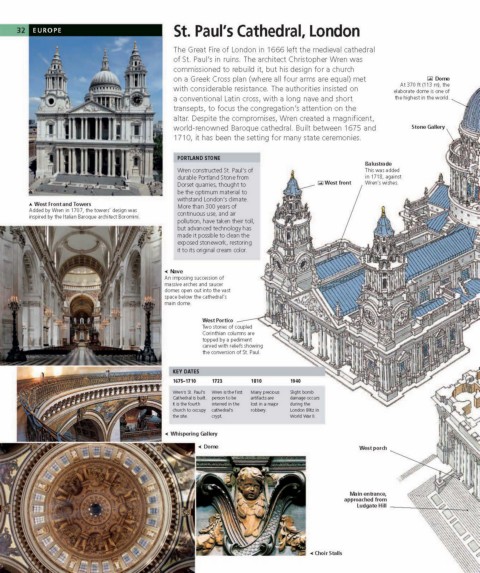
                                                     The Great Fire of London in  1666 left the medieval cathedral
                                                     of St.  Paul's in  ruins.  The architect Christopher Wren was
                                                     commissioned to rebuild  it,  but his design for a church
                                                     on a Greek Cross plan (where all four arms are equal) met                  ii;iJ  Dome
                                                                                                                        At 370 tt  (113!'1V, the
                                                     with considerable resistance.  The authorities insisted on       elaborate dOI'Tle is one of
                                                     a conventional Latin cross, with a long nave and short            the highest in the world.
                                                     transepts,  to focus the congregation's attention on the
                                                     altar.  Despite the compromises, Wren created a magnificent,
                                                     world-renowned  Baroque cathedral.  Bu ilt between 1675 and
                                                     1710, it has  been  the setting for many state ceremonies.


                                                      PORTLAND STONE
                                                                                                              Balustrade
                                                      Wren constructed St.  Paul's of                         This was added
                                                      durable Portland Stone from                             in 1718, against
                                                      Dorset quarries, thought to                             Wren's wishes.
                                                      be the optimum material to
                                                      withstand London's climate.
         A  West Front  and Towers                    More than 300 years of
         Added by Wren  in 1707, the towers'  design was
          inspired by the Italian Baroque architect Boromini.   continuous use, and air
                                                      pollution, have taken their toll,
                                                      but advanced technology has
                                                      made it possible to dean the
                                                      exposed stoneiNork, restoring
                                                      it to its original cream color.


                                                  An i!l1>osing succession of
                                                  massive arches and saucer
                                                  domes open out into the vast
                                                  space belcm the cathedral's
                                                  main dome.

                                                             West Portico
                                                             Two stories of coupled
                                                             Corinthian columns are
                                                             topped by a pediment
                                                             carved with reliefs  showing
                                                             the conversion of St. Paul.


                                                    KEY DATES
                                                     1675-1710   172?.      1810        1940
                                                    Vvl'en·s St. Paul's   Wren is the  first   Many precbus   S light bomb
                                                    cathedral is buik.  person to be   artifacts are   damage occurs
                                                    l  is the fourth   interred in the   lost In a major   during the
                                                    church to occupy  cathedral's   robbel)'.   LOndon  Bl~z in
                                                    the site.   Cl)'p\.                World \Mir II.


                                                                                                         Main entrance,
                                                                                                        approached from
                                                                                                           Ludgate Hill  ----1~~~~@.~~


                                                                                             -<Choir Stalls

