


Page 36 - DK Eyewitness Travel Guides - The World's Must-See Places
P. 36
34  EUROPE                                       The Tower of London


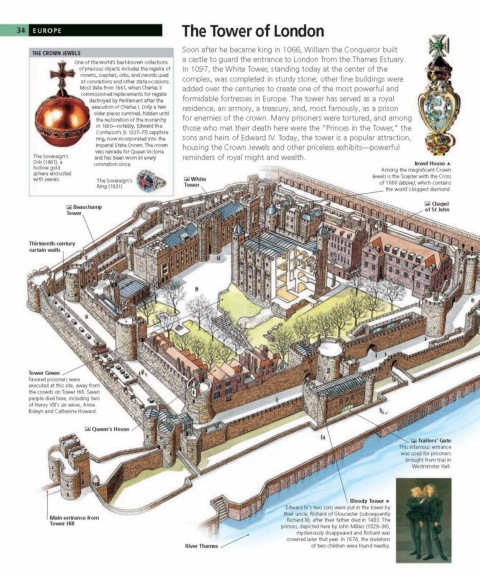
                                                       Soon after he became king in  1066, William the Conqueror built
          THE CROWN JEWELS
                                                       a castle to guard the entrance to London  from the Thames Estuary.
                       One of the world's best-known collections
                        of precious objects includes the regalia of   In  1097, the White Tower, standing today at the center of the
                         crowns, scepters, orbs, and swords used
                         at coronations and other state occasions.   complex, was completed  in  sturdy stone;  other fine buildings were
                         Most date from 1661, when Charles II   added over the centuries  to create one of the most powerful and
                         commissioned replacements for regalia
                           destroyed by Parliament after the   formidable fortresses in  Europe.  The tower has served  as  a royal
                            execution of Charles 1.  Only a few   residence, an armory, a treasury, and, most famously, as  a prison
                             older pieces survived, hidden until
                             the restoration of the monarchy   for enemies of the crown. Many prisoners were tortured, and  among
                              in 1660-notably, Edward the   those who met their death here were the "Princes in  the Tower,"  the
                              Confessor's (r.  1327-77) sapphire
                             ring, now incorporated into the   sons and heirs of Edward IV  Today, the tower is  a popular attraction,
                             Imperial State Crown. The crown   housing the Crown Jewels and other priceless exhibits-powerful
                             was rem a de for Queen Victoria
           The Sovereign's   and has been worn at every   reminders of royal  might and wealth.
           Orb (1661), a
                             coronation since.                                                                              Jewel House A
           hollow gold                                                                                            Among the magnificent Crown
           sphere encrusted
           with jewels        The Sovereign's  ~- ~·                                                            Jewels is the Scepter with the Cross
                                                                                                                  of 1660 (above), which contains
                              Ring (1831)   ~J~
                                                                                                                    the world's biggest diamond.
                                                                                                                               Gil Chapel
                     Gil Beauchamp                                                                                              of StJohn
                     Tower


          Thirteenth-century
          curtain walls


         Tower Green
         Favored prisoners were
         executed at this site, away from
          the crowds on Tower Hill. Seven
         people died here, including  two
         of Henry VIII's six wives, Anne
         Boleyn and Catherine Howard.


                                                                                                                        was used for prisoners
                                                                                                                          brought from trial in
                                                                                                                            Westminster Hall.


                                                                                                         Bloody Tower >
                                                                                      Edward IV's two sons were put in the tower by
                                                                                      their uncle, Richard of Gloucester (subsequently
                Main entrance from                                                    Richard Ill), after their father died in  1483. The
                Tower Hill
                                                                                     princes, depicted here by John Milia is (1829-96),
                                                                                         rcysteri ously disappeared and Richard was
                                                                                      crowned later that year. In 1674, the skeletons
                                                        River Thames  /                       of two children were found nearby.

