


Page 40 - DK Eyewitness Travel Guides - The World's Must-See Places
P. 40
38  EUROPE                                     Stonehenge


                                                     Built in several stages  from about 3000 BC,
                                                     Stonehenge is  Europe's most famous  prehistoric
                                                     monument. We can only guess at the rituals that
            ATLANTIC
             OCEAN                                   took place here, but the alignment of the stones
                                   NORTH
                                    SEA              leaves little doubt that the circle is connected with
                          GREAT
                         B£ UTAIN                    the sun and the passing of the seasons, and that its
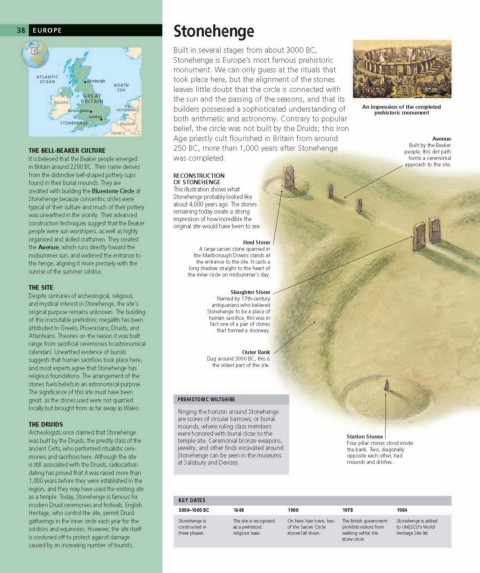
                                                     builders possessed a sophisticated understanding of     An impression of the completed
                                                                                                                 prehistoric monument
                                                     both arithmetic and astronomy. Contrary to popular
                                                     belief, the circle was not built by the Druids; this Iron
                                                     Age priestly cult flourished  in  Britain  from around                       Avenue
                                                                                                                           Built by the  B e ake r
         THE BELL-BEAKER CULTURE                     250 BC,  more than  1,000 years after Stonehenge                     people,  this  dirt path
         It is  believed that the  Beaker people emerged   was completed.                                                  forms  a  ce re monia l
         in Britain around 2  2  00 BC.  Their name derives                                                               approac h to the  s ite.
         from the distinctive  bell-shaped pottery cups   RECONSTRUCTION
         found in their burial mounds, They are      OF STONEHENGE
         credite d with building the  Bluestone Circle at   This illustration shows what
         Stonehenge because concentric circles were   Stonehenge probably looked like
                                                     about 4,000 years ago. The stones
         typical of the ir culture and much of their pottery
         was unearthed in the  vicinity. Their advanced   remaining today create a strong
                                                     impression of how incredible  the
         construction techniques s uggest that the  Beaker   original site would have been to see.
         people were s un worshipers, as well as highly
         organized and skilled craftsmen  They created                   Heel S tone
         the Avenue, wh1ch runs d1rectly toward the         A la rge  s a rsen stone quarried in
         midsummer sun, and widened the entrance to        the  Ma rlborough DCMII'ls stands at
         the henge, aligning 1t more predsely wrth the     the  entrance to the site.lt  casts a
                                                         long sha dcm straight to the heart of
         sunrise of  the summer solstice
                                                         the  inner cirde on mdsunmer's  day.
         THE SITE
                                                                      Slaughter S tone
         Despite centunes of archeological, rehg1ous,             Na med by 17th-century
                                                                fact one  of a pair of stones y
         and mystical interest 10 Stonehenge, the site's        antiquarians  who beliwed
         original purpose rema1 ns unknown. The building       S tonehenge to  be a  place of
                                                               human sacrifice. this  was in
         of this inscrutable  prehistoric megalith has been
         attributed to Greeks, P hoenicians, Druids , and         that formed a doorway.
         Atlanteans. Theories on the  reason it  was  built
         range  from sacrifi  cia  I ceremonies to astronomical
         calendars. Unearthed evide nce of burials                       Outer Bank
         suggests  that human sacrifices took place here,      Dug around 3000  B C , this  is
                                                                the oldest part of the s ite.
         and most experts  agree that S tonehenge has
         rei igious  foundations. The arrangement of the
         stones fuels  beliefs  in an astronomical purpose.
         The s ignificance of this  s ite  must have  been
         great, as the stones used were not quarried   PREHISTORIC WILTSHIRE
         locally but brought from as far away as Wales.
                                                      Ringing the horizon around S tonehenge
                                                      are scores of circular barrows , or burial
         THE DRUIDS                                   mounds , where ruling class members
         Archeologists once cla1med that Stonehenge   were honcred with burial dose to the              Station Stones
         was built by the Dru1ds, the pnestly class of the   temple  site. Ceremonial bronze weapons,   F our pilla r stones stood inside
          andent Celts, who performed ntuahstiC cere-  jewelry, and other finds excavated around        the  ban k. lWo. dia gona lly
         monies and sa entices here  Although the Site   Stonehenge can be seen in the museums          opposite each othe r, ha d
         is still assooated wth the Dru1ds, radocarbon   at Salisbury and Devizes.                      mounds  a nd ditches.
         dating has proved that rt was ra1sed more than
          1,000 years before they were established in the
         region, and they may have used the existing site
         as a temple.  T oday, Stonehenge IS famous for
                                                      KEY DATES
         modern Druid ceremonies and festivals. Eng  I  ish
                                                      300~1000  BC     1648            1900            1978            1984
          Heritage, who control the s ite, perm1t Druid
         gatherings in the  inner circle each yearfor the   Stonehenge is   The site Is recognized   On New  Year's eve, two   The British government   S tonehenge is added
         solstices and equinoxes. However, the s ite itself   constructed in   as a prehistoric   of the Sarcen Circle   prohibits  visitors from   to UNESCO's World
                                                      three phases.   religious~.      stones fall down.   walking w~hin  the   Heritage Site list.
         is cordoned off to protect against damage                                                     stone circle.
         caused by an increas ing number of tourists.

