


Page 40 - (DK Eyewitness) Travel Guide - Australia
P. 40
38 INTRODUCING A USTR ALIA
Australian Artists and Writers
The first Europeans to paint Australia were those who
arrived on the Endeavour (see pp54–5), but it was not until
the prosperity generated by the 1850s gold rushes that art
gained any public recognition. There had been colonial
artists, of whom Conrad Martens (1801–78) was the best
known, but in a country where survival was the most
immediate problem, art was not a high priority. The first
writings were also journals of early settlers; it was 100 years
before Australia could claim the beginnings of a literary Artist Sir Russell Drysdale
tradition, when Rolf Boldrewood (1826–1915) wrote
Robbery Under Arms (1888), a heroic tale of the bush. wrong reasons. Possibly the
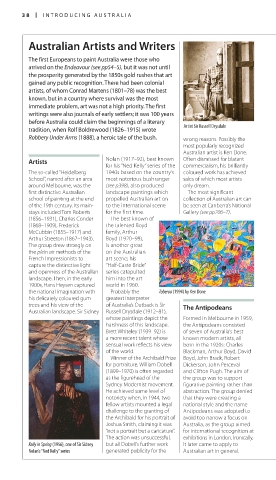
most popularly recognized
Australian artist is Ken Done.
Artists Nolan (1917–92), best known Often dismissed for blatant
for his “Ned Kelly” series of the commercialism, his brilliantly
The so-called “Heidelberg 1940s based on the country’s coloured work has achieved
School”, named after an area most notorious bushranger sales of which most artists
around Melbourne, was the (see p398), also produced only dream.
first distinctive Australian landscape paintings which The most significant
school of painting at the end propelled Australian art on collection of Australian art can
of the 19th century. Its main- to the international scene be seen at Canberra’s National
stays included Tom Roberts for the first time. Gallery (see pp206–7).
(1856–1931), Charles Conder The best known of
(1868–1909), Frederick the talented Boyd
McCubbin (1855–1917) and family, Arthur
Arthur Streeton (1867–1943). Boyd (1920–99),
The group drew strongly on is another great
the plein air methods of the plein air methods of the plein air on the Australian
French Impressionists to art scene; his
capture the distinctive light “Half-Caste Bride”
and openness of the Australian series catapulted
landscape. Then, in the early him into the art
1900s, Hans Heysen captured world in 1960.
the national imagination with Probably the Toberua (1994) by Ken Done
his delicately coloured gum greatest interpreter
trees and his view of the of Australia’s Outback is Sir The Antipodeans
Australian landscape. Sir Sidney Russell Drysdale (1912–81),
whose paintings depict the Formed in Melbourne in 1959,
harshness of this landscape. the Antipodeans consisted
Brett Whiteley (1939–92) is of seven of Australia’s best-
a more recent talent whose known modern artists, all
sensual work reflects his view born in the 1920s: Charles
of the world. Blackman, Arthur Boyd, David
Winner of the Archibald Prize Boyd, John Brack, Robert
for portraiture, William Dobell Dickerson, John Perceval
(1899–1970) is often regarded and Clifton Pugh. The aim of
as the figurehead of the the group was to support
Sydney Modernist movement. figurative painting rather than
He achieved some level of abstraction. The group denied
notoriety when, in 1944, two that they were creating a
fellow artists mounted a legal national style and the name
challenge to the granting of Antipodeans was adopted to
the Archibald for his portrait of avoid too narrow a focus on
Joshua Smith, claiming it was Australia, as the group aimed
“not a portrait but a caricature”. for international recognition at
The action was unsuccessful, exhibitions in London. Ironically,
Kelly in Spring (1956), one of Sir Sidney but all Dobell’s further work it later came to apply to
Nolan’s “Ned Kelly” series generated publicity for the Australian art in general.

