


Page 39 - (DK Eyewitness) Travel Guide - Australia
P. 39
a por tr ait of a ustr alia 37
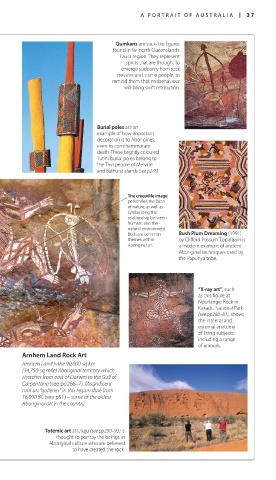
Quinkans are stick-like figures
found in far north Queensland’s
Laura region. They represent
spirits that are thought to
emerge suddenly from rock
crevices and startle people, to
remind them that misbehaviour
will bring swift retribution.
Burial poles are an
example of how important
decoration is to Aborigines,
even to commemmorate
death. These brightly coloured
Tutini burial poles belong to
the Tiwi people of Melville
and Bathurst islands (see p278).
The crocodile image
personifies the force
of nature, as well as
symbolizing the
relationship between
humans and the
natural environment.
Both are common Bush Plum Dreaming (1991)
themes within by Clifford Possum Tjapaltjarri is
Aboriginal art. a modern example of ancient
Aboriginal techniques used by
the Papunya tribe.
“X-ray art”, such
as this figure at
Nourlangie Rock in
Kakadu National Park
(see pp280–81), shows
the internal and
external anatomy
of living subjects,
including a range
of animals.
Arnhem Land Rock Art
Arnhem Land is the 90,000-sq km
(34,750-sq mile) Aboriginal territory which
stretches from east of Darwin to the Gulf of
Ca (see pp266–7). Magnificent
Ca
Carpentaria rpentaria r
rock art “galleries” in this region date from
16,000 BC (see p51) – some of the oldest
Aboriginal art in the country.
Totemic art at Uluru (see pp290–93) is
thought to portray the beings in
Aboriginal culture who are believed
to have created the rock.

