


Page 37 - (DK Eyewitness) Travel Guide - Australia
P. 37
A POR TR AIT OF A USTR ALIA 35
have two souls – one mortal
and one immortal, linked with
their ancestral spirit (or totem).
Each family clan is descended
from the same ancestral being.
These spirits provide
protection: any misfortune is
due to disgruntled forebears.
As a consequence, some clan
members have a responsibility
for maintaining sacred sites.
Anyone failing in these duties
is severely punished.
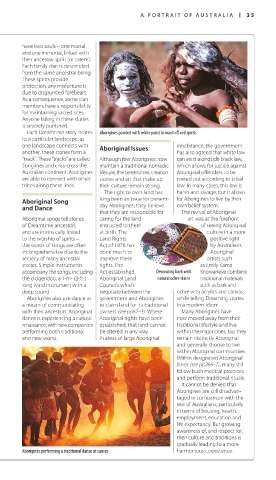
Each Dreamtime story relates Aborigines painted with white paint to ward off evil spirits
to a particular landscape; as
one landscape connects with Aboriginal Issues inhabitance, the government
another, these stories form a has also agreed that white law
“track”. These “tracks” are called Although few Aborigines now can exist alongside black law,
Songlines and criss-cross the maintain a traditional nomadic which allows for justice against
Australian continent. Aborigines lifestyle, the ceremonies, creation Aboriginal offenders to be
are able to connect with other stories and art that make up meted out according to tribal
tribes along these lines. their culture remain strong. law. In many cases, this law is
The right to own land has harsh and savage, but it allows
Aboriginal Song long been an issue for present- for Aborigines to live by their
and Dance day Aborigines; they believe own belief system.
that they are responsible for The revival of Aboriginal
Aboriginal songs tell stories caring for the land art was at the forefront
of Dreamtime ancestors entrusted to them of seeing Aboriginal
and are intrinsically linked at birth. The culture in a more
to the worship of spirits – Land Rights positive light
the words of songs are often Act of 1976 has by Australians.
incomprehensible due to the done much to Aboriginal
secrecy of many ancestral improve these artists such
stories. Simple instruments rights. The as Emily Kame
accompany the songs, including Act established Decorating bark with Kngwarreye combine
the didgeridoo, a 1-m- (3-ft-) Aboriginal Land natural ochre stains traditional materials
long wind instrument with a Councils which such as bark and
deep sound. negotiate between the ochre with acrylics and canvas,
Aborigines also use dance as government and Aborigines while telling Dreaming stories
a means of communicating to claim land for its traditional in a modern idiom.
with their ancestors. Aboriginal owners (see pp62–3). Where Many Aborigines have
dance is experiencing a cultural Aboriginal rights have been now moved away from their
renaissance, with new companies established, that land cannot traditional lifestyle and live
performing both traditional be altered in any way. within the major cities, but they
and new works. In areas of large Aboriginal remain distinctly Aboriginal
and generally choose to live
within Aboriginal communities.
Within designated Aboriginal
lands (see pp266–7), many still
follow bush medical practices
and perform traditional rituals.
It cannot be denied that
Aborigines are still disadvan-
taged in comparison with the
rest of Australians, particularly
in terms of housing, health,
employment, education and
life expectancy. But growing
awareness of, and respect for,
their culture and traditions is
gradually leading to a more
Aborigines performing a traditional dance at sunset harmonious coexistence.

